
The global AI for scientific discovery sector was valued at USD 4.80 billion in 2025 and is projected to reach USD 5.85 billion in 2026 and approximately USD 34.78 billion by 2035, expanding at a CAGR of 21.90% from 2026 to 2035.
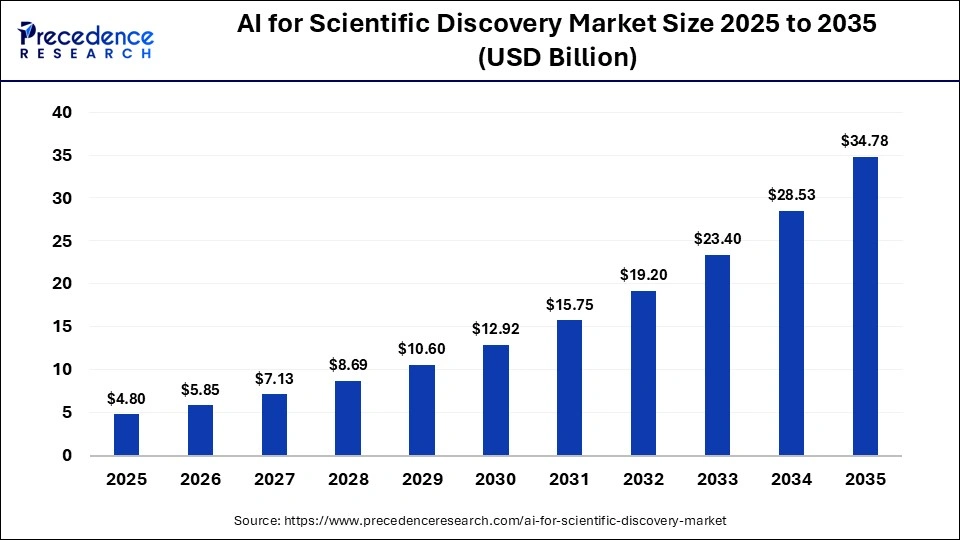
The rapid expansion is being driven by massive scientific data generation, advances in high-performance computing, growing adoption of machine learning, and increasing use of generative AI for drug discovery and advanced research.
Download a Sample Report: https://www.precedenceresearch.com/sample/7938
AI for Scientific Discovery Overview
AI for scientific discovery refers to the use of artificial intelligence platforms, algorithms, computational models, and services to accelerate scientific research. These technologies are being applied across drug development, genomics, biomedical research, chemistry, materials science, physics, astronomy, and environmental modelling.
Machine learning and deep learning can process complex datasets far faster than traditional analytical methods, helping researchers identify patterns, predict outcomes, and prioritize promising research directions. Generative AI is taking this further by creating new molecular structures, simulating experiments, predicting material properties, and helping scientists develop new hypotheses before costly laboratory testing.
How AI Is Creating a New Era of Scientific Breakthroughs
AI is becoming an important research partner rather than simply an analytical tool. Advanced algorithms can evaluate genomic sequences, protein structures, chemical libraries, scientific literature, and experimental datasets simultaneously. This allows researchers to identify connections that may be difficult to detect through conventional approaches.
In drug discovery, AI can support target identification, molecular screening, drug design, and prediction of potential interactions. In materials science, AI models can estimate physical and chemical properties before a material is synthesized. These capabilities can reduce repetitive experimentation, shorten research cycles, and improve the efficiency of scientific innovation.
Powerful Trends Shaping AI for Scientific Discovery
Generative AI Is Accelerating Research
Generative AI models are increasingly being used to design molecules, generate scientific hypotheses, simulate experiments, and explore alternative research pathways. Their ability to produce and evaluate multiple possibilities rapidly is helping researchers reduce time spent on trial-and-error experimentation.
Multimodal AI Is Unlocking Complex Data
Scientific research produces data in many forms, including text, images, numerical datasets, molecular structures, and biological sequences. Multimodal AI can combine these sources to generate more comprehensive scientific insights and improve prediction accuracy.
High-Performance Computing Is Becoming Essential
Large scientific AI models require powerful computing infrastructure, advanced GPUs, high-speed networking, and scalable storage. Cloud-based high-performance computing is allowing universities, laboratories, pharmaceutical companies, and technology firms to access significant computational power without building all infrastructure internally.
Explainable AI Is Building Scientific Trust
Researchers increasingly need to understand why an AI system generated a particular prediction. Explainable AI is therefore becoming more important for scientific validation, reproducibility, regulatory documentation, and responsible deployment of AI-generated research findings.
Secure Scientific Data Sharing Is Expanding
Confidential research datasets require strong privacy protections. Technologies such as synthetic data, secure computation, and encryption are helping organizations collaborate while reducing the risks associated with sharing sensitive scientific information.
AI Software Platforms Continue to Lead
The AI software platforms segment held the largest share of approximately 44% in 2025. These platforms provide researchers with tools for analyzing large datasets, running predictive models, performing molecular simulations, and automating research workflows.
Their scalability and ability to support multiple scientific applications make them valuable to pharmaceutical companies, biotechnology firms, research institutions, and industrial laboratories. The data infrastructure and high-performance computing platforms segment is expected to record the fastest growth as increasingly sophisticated AI models require greater processing power, storage, and networking capabilities.
Machine Learning Remains a Core Technology
The machine learning algorithms segment accounted for approximately 36% of the total share in 2025. Machine learning is widely used for pattern recognition, prediction, classification, molecular analysis, and scientific modelling.
The generative AI models segment is expected to expand at the fastest rate. These systems can generate molecular structures, simulate possible experimental outcomes, and support new approaches to drug and material development. Their ability to reduce physical experimentation and accelerate candidate selection is attracting significant investment.
Drug Discovery and Biomedical Research Lead Applications
The drug discovery and biomedical research segment represented nearly 34% in 2025. Pharmaceutical and biotechnology companies are using AI to analyze biological information, identify therapeutic targets, predict drug interactions, and prioritize promising candidates.
The materials science and chemistry discovery segment is projected to grow at the fastest pace. AI can evaluate large numbers of chemical combinations and predict material characteristics before laboratory synthesis. This can support faster development of advanced materials, sustainable chemicals, catalysts, and energy-related technologies.
Pharmaceutical and Biotechnology Companies Drive Adoption
The pharmaceutical and biotechnology companies segment held approximately 36% of the share in 2025. These organizations are actively adopting AI to improve research efficiency, reduce development timelines, and manage increasingly complex biological datasets.
Research institutes also play a critical role by developing new AI models, generating scientific datasets, and validating emerging computational methods. Meanwhile, chemicals and materials companies are increasingly using AI to optimize formulations, discover new compounds, and develop more sustainable production approaches.
North America Leads the Global Landscape
North America accounted for approximately 40% of the share in 2025, supported by strong research capabilities, significant private and public investment, advanced computing infrastructure, and a highly developed pharmaceutical and technology ecosystem.
The United States remains a major contributor because of its strong network of universities, national laboratories, pharmaceutical companies, biotechnology firms, and technology providers. Organizations and agencies supporting scientific research are increasingly exploring AI to improve research productivity and accelerate innovation.
Asia Pacific Is Emerging as a Powerful Growth Engine
Asia Pacific is projected to experience the fastest growth during the forecast period. Expanding biotechnology capabilities, rising government investment, a growing scientific workforce, and increasing adoption of AI across pharmaceuticals, chemicals, materials, and life sciences are creating strong momentum.
China is emerging as a major contributor due to its expanding AI ecosystem, large scientific talent base, growing research infrastructure, and increasing integration of AI into biotechnology and computational research. Other countries across the region are also investing in AI-enabled research infrastructure and advanced scientific computing.
Europe is progressing through government-backed research initiatives, strong academic institutions, and established pharmaceutical and chemical sectors. Programs supporting AI research and digital innovation are encouraging wider adoption across scientific disciplines.
Recent AI for Scientific Discovery Developments
In February 2026, Tamarind Bio secured USD 13.6 million in Series A funding to expand access to AI tools for life science researchers through a large library of scientific models.
In February 2026, Google DeepMind introduced a national partnership for AI collaboration in India, expanding access to research technologies such as AI Co-Scientist, Earth AI, and AlphaGenome.
These developments highlight the growing focus on making advanced AI capabilities more accessible to scientists and research organizations.
Future Outlook for AI for Scientific Discovery
The future of AI for scientific discovery is exceptionally promising as researchers increasingly combine artificial intelligence with high-performance computing, automation, multimodal datasets, and advanced scientific modelling. The technology is moving beyond simple prediction toward hypothesis generation, autonomous experimentation, and highly accelerated discovery workflows.
The global sector is projected to reach approximately USD 34.78 billion by 2035, reflecting the powerful role of AI in accelerating drug discovery, biomedical research, materials innovation, and broader scientific breakthroughs.
Buy this report: https://www.precedenceresearch.com/checkout/7938
About Us
Healthcare Prism is a dedicated healthcare insights and outreach platform, operating as an extension of Precedence Research. We share relevant perspectives, industry developments, emerging trends, and research-driven insights across the global healthcare sector. Our content is built on the knowledge, research standards, and expertise of Precedence Research, with a focus on making healthcare information clear, accessible, and useful for industry professionals, businesses, researchers, and healthcare stakeholders. Healthcare Prism serves as a focused platform to extend the reach of Precedence Research’s healthcare insights and connect them with a broader professional audience.
You can place an order or ask any questions, please feel free to contact us at [email protected]
Quick Contact:
Europe Region: +44 778 256 0738
North America Region: +1 8044 4193 44
APAC Region: +91 9356 9282 04 and +65 31065601
Visit Our Website: Precedence Research – Advisory, Research & Reports