
The global varicose veins treatment sector was valued at USD 1.59 billion in 2025 and is projected to reach USD 1.69 billion in 2026 and approximately USD 2.96 billion by 2035, expanding at a CAGR of 6.44% from 2026 to 2035.
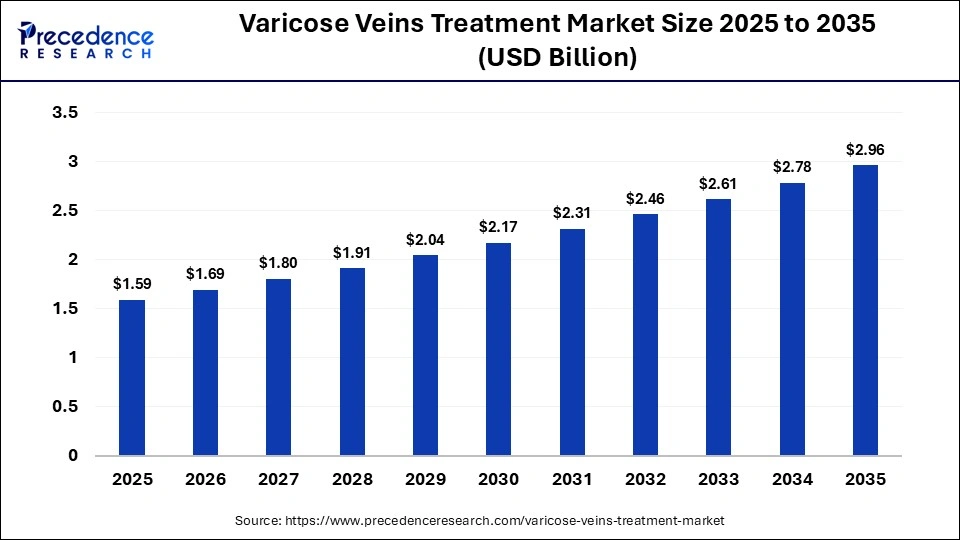
Growth is being driven by the increasing prevalence of venous disorders, an aging population, greater awareness of vein health, and rising preference for minimally invasive treatment options.
Download a Sample Report: https://www.precedenceresearch.com/sample/7895
Varicose Veins Treatment Overview
Varicose veins are enlarged and twisted veins that commonly develop in the legs because of weakened or damaged valves. Treatment options range from conservative management and injection sclerotherapy to endovenous laser therapy, radiofrequency ablation, and surgical procedures.
The treatment landscape is changing as patients increasingly prefer procedures that provide effective vein closure with less discomfort, shorter recovery periods, and reduced hospital stays. Improvements in catheter-based technologies, imaging, and outpatient care are making advanced procedures more accessible across hospitals, specialty clinics, and ambulatory surgical centers.
AI Is Transforming Varicose Veins Diagnosis and Treatment
Artificial intelligence is creating new opportunities in varicose veins treatment by supporting diagnostic accuracy, treatment planning, and risk assessment. AI-assisted imaging can help physicians evaluate vein structure, identify abnormal blood flow patterns, and assess disease severity.
Predictive analytics can also help identify patients who may be at higher risk of developing chronic venous insufficiency or experiencing recurrence. As healthcare providers adopt data-driven technologies, AI-supported tools can contribute to more personalized treatment decisions and improved clinical workflows.
Powerful Trends Shaping Varicose Veins Treatment
Rising Adoption of Minimally Invasive Procedures
Laser ablation, radiofrequency ablation, and sclerotherapy are increasingly preferred because they can reduce recovery time and minimize surgical trauma. Growing patient awareness of these options is encouraging earlier treatment.
Growth of Outpatient Care
Many vein procedures are shifting toward ambulatory and office-based settings. These facilities can offer faster discharge, lower treatment costs, and greater convenience for patients.
Increasing Cosmetic Awareness
Growing attention to appearance is encouraging individuals to seek treatment earlier for visible varicose veins. This is increasing demand for procedures that combine functional improvement with cosmetic benefits.
Advancement in Vein Treatment Technologies
Manufacturers are developing sophisticated catheters, imaging technologies, and non-thermal treatment systems that can improve procedural precision and patient comfort. These innovations are expanding the range of available treatment options.
Injection Sclerotherapy Maintains Strong Adoption
The injection sclerotherapy segment held the largest position in 2025 because the procedure is minimally invasive, relatively affordable, and suitable for treating small to medium-sized varicose veins. It can generally be performed in outpatient settings and does not require major surgery.
The endovenous ablation segment is expected to grow at the fastest rate during the forecast period. Laser and radiofrequency technologies allow physicians to close diseased veins through minimally invasive techniques while supporting faster recovery. Increasing physician preference for image-guided procedures and growing patient demand for durable results are further supporting adoption.
Hospitals Continue to Lead End Use
The hospitals segment accounted for the largest share in 2025 because hospitals provide comprehensive diagnostic, procedural, and post-treatment services. Advanced vascular specialists, imaging systems, surgical facilities, and emergency support make hospitals suitable for patients with complex venous conditions.
The ambulatory surgical centers segment is expected to experience strong growth. Patients increasingly prefer convenient outpatient treatment, while healthcare providers benefit from efficient workflows, shorter stays, and lower operating costs. These advantages are encouraging the expansion of advanced vein procedures outside traditional hospital environments.
North America Leads the Global Landscape
North America held the leading position in 2025 due to advanced healthcare infrastructure, high adoption of minimally invasive procedures, strong patient awareness, and favorable reimbursement conditions. The United States remains a major contributor, supported by established vascular care networks, technological innovation, and growing demand for outpatient vein procedures.
Asia Pacific is expected to experience the fastest growth through 2035. Expanding healthcare infrastructure, increasing disposable incomes, greater awareness of venous disorders, and the growth of specialty hospitals and clinics are supporting treatment adoption. India is becoming an important contributor as advanced vein procedures become more accessible and medical tourism continues to expand.
Europe is also progressing steadily due to established healthcare systems, increasing adoption of endovenous procedures, and a growing elderly population. Germany remains an important contributor because of its advanced medical infrastructure and strong focus on minimally invasive healthcare technologies.
Recent Innovations Strengthen the Treatment Landscape
In February 2026, InVera Medical received European CE Mark approval for its InVera Infusion Device, a non-thermal minimally invasive technology designed to treat diseased leg veins in office-based settings without tumescent anesthesia.
In February 2025, Aakash Healthcare and Medtronic launched a specialized vein clinic in New Delhi, providing advanced diagnosis and minimally invasive treatment options for varicose veins.
These developments demonstrate the continued shift toward patient-friendly procedures, specialized vein care, and advanced technologies.
Future Outlook for Varicose Veins Treatment
The future of varicose veins treatment is being shaped by minimally invasive technologies, outpatient care, advanced imaging, AI-assisted diagnosis, and greater emphasis on patient comfort. Non-thermal technologies and next-generation catheter systems are expected to create additional treatment options while supporting faster recovery.
With the global sector projected to reach approximately USD 2.96 billion by 2035, continued technological innovation, growing awareness, and expanding access to specialized vascular care are expected to strengthen treatment adoption worldwide.
Buy this report: https://www.precedenceresearch.com/checkout/7895
About Us
Healthcare Prism is a dedicated healthcare insights and outreach platform, operating as an extension of Precedence Research. We share relevant perspectives, industry developments, emerging trends, and research-driven insights across the global healthcare sector. Our content is built on the knowledge, research standards, and expertise of Precedence Research, with a focus on making healthcare information clear, accessible, and useful for industry professionals, businesses, researchers, and healthcare stakeholders. Healthcare Prism serves as a focused platform to extend the reach of Precedence Research’s healthcare insights and connect them with a broader professional audience.
You can place an order or ask any questions, please feel free to contact us at [email protected]
Quick Contact:
Europe Region: +44 778 256 0738
North America Region: +1 8044 4193 44
APAC Region: +91 9356 9282 04 and +65 31065601
Visit Our Website: Precedence Research – Advisory, Research & Reports