
The AI in omics studies sector is entering a powerful phase of growth as pharmaceutical companies, biotechnology firms, and research institutions increasingly use artificial intelligence to analyze complex biological data. The global sector was valued at USD 1.25 billion in 2025 and is projected to reach approximately USD 6.11 billion by 2035, expanding at a CAGR of 17.20% from 2026 to 2035.
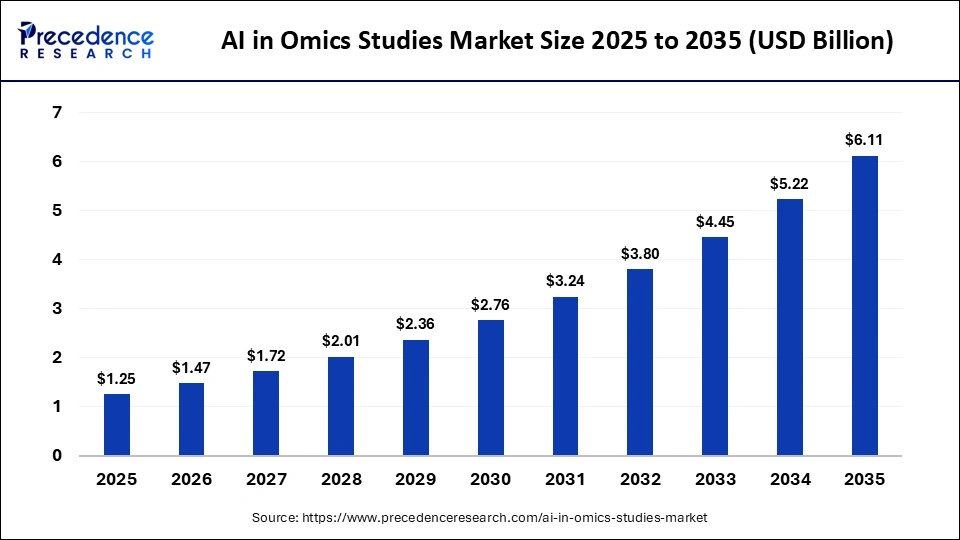
Growing demand for precision medicine, faster drug discovery, rare disease research, and advanced biological data analysis is driving this expansion.
Download a Sample Report: https://www.precedenceresearch.com/sample/8296
AI Is Unlocking the Power of Multi Omics Data
Omics research generates enormous amounts of information across genomics, proteomics, transcriptomics, and metabolomics. Traditional analytical methods often struggle to process these datasets at the speed and scale required for modern biomedical research.
AI and machine learning are changing this process by identifying complex patterns, biological relationships, and disease signatures across multiple data layers. Instead of analyzing one biological factor in isolation, researchers can combine genetic mutations, gene expression, protein activity, and metabolic changes to develop a more complete understanding of disease.
This capability is especially valuable for complex conditions such as cancer, rare diseases, neurological disorders, and autoimmune diseases.
Precision Medicine Is Accelerating Adoption
The growing demand for personalized medicine is one of the strongest growth drivers for AI in omics studies. Healthcare providers and researchers are increasingly focused on understanding why patients respond differently to the same treatment.
AI can analyze large genomic and clinical datasets to identify biomarkers linked to disease progression and treatment response. These insights can help researchers develop more targeted therapies and support patient-specific treatment strategies.
As precision medicine expands, AI-powered omics platforms are becoming increasingly important for identifying the right therapeutic targets and improving treatment selection.
Drug Discovery Is a Major Growth Engine
Drug discovery accounted for the largest application share in 2025 at 35%. Pharmaceutical and biotechnology companies are using AI to accelerate target identification, molecular screening, biomarker discovery, and candidate prioritization.
AI can evaluate large biological and chemical datasets much faster than conventional approaches. This can help researchers identify promising compounds, understand disease mechanisms, and reduce the time required for early-stage drug development.
The technology is also becoming valuable in rare disease research, where limited patient populations and complex biological mechanisms make traditional discovery approaches particularly challenging.
AI Is Making Omics Research More Intelligent
One of the major trends is the shift from statistical analysis toward more biologically meaningful AI models. Researchers are increasingly developing systems that prioritize biological relevance rather than relying solely on statistical associations.
Another important development is the growing adoption of Explainable AI. Researchers and healthcare organizations want AI systems to provide understandable reasoning behind their results, particularly when the findings may influence clinical research or therapeutic development.
Multi-omics AI platforms are also emerging as powerful tools for identifying disease signatures that cannot be detected through a single omics layer.
Genomics Continues to Lead
The genomics segment accounted for 40% of the sector in 2025, supported by the rapid growth of sequencing data and the increasing use of AI for variant analysis, genomic interpretation, biomarker identification, and personalized medicine.
Lower sequencing costs and broader access to genomic technologies are generating even larger datasets, creating greater demand for advanced computational tools.
Proteomics represented the second-largest segment with a 20% share in 2025 and is expected to expand at a 17.5% CAGR through 2035. AI is particularly useful in proteomics because of the complexity and volume of protein-related data generated through modern laboratory technologies.
Transcriptomics and metabolomics are also gaining momentum as researchers seek deeper insights into gene expression, cellular activity, and metabolic pathways.
Software Is Driving the Digital Transformation
Software held the largest component share at 55% in 2025. AI-powered software platforms provide scalable tools for automated data processing, variant calling, biological interpretation, and multi-omics integration.
These platforms can reduce manual workloads while helping researchers manage increasingly complex datasets. Cloud-based systems are also improving collaboration by allowing research teams to securely access and analyze data across locations.
The services segment is expected to grow at a 16.5% CAGR, supported by rising demand for specialized AI implementation, data management, regulatory support, and customized analytics.
Hospitals and Research Centers Are Expanding Their Role
Pharmaceutical and biotechnology companies represented the largest end-use segment with a 50% share in 2025. These organizations are using AI in omics studies to shorten development timelines, discover new biological targets, and support personalized treatment programs.
Research institutes accounted for 25%, reflecting their important role in generating biological datasets and developing new analytical methods. Hospitals and clinics are expected to grow at the fastest rate among major end users, with an 18% CAGR, as precision diagnostics and personalized medicine become more integrated into clinical care.
North America Holds a Strong Leadership Position
North America accounted for approximately 42% of the global sector in 2025, supported by high research and development spending, advanced biotechnology infrastructure, and rapid adoption of AI technologies.
The United States remains a major innovation center because of its strong pharmaceutical ecosystem, leading universities, technology companies, and government-supported genomic research programs.
Organizations across the country are increasingly combining AI with genomics, spatial biology, and clinical datasets to improve drug discovery and disease understanding.
Asia Pacific Is Emerging as a Powerful Growth Region
Asia Pacific is expected to grow at the fastest rate, with a projected 19.5% CAGR from 2026 to 2035. Rapid healthcare digitization, increasing genomic research, large patient datasets, and expanding biotechnology capabilities are supporting regional growth.
China is becoming a significant contributor through government-backed AI initiatives, genomic research programs, and investments in biotechnology infrastructure. The region’s large and diverse population also provides extensive datasets that can support AI model development and precision medicine research.
How Leading Companies Are Positioning
Leading companies are strengthening their positions through AI platforms, high-performance computing, cloud-based analytics, and integrated multi-omics solutions.
Illumina continues to strengthen its genomic ecosystem, while Thermo Fisher Scientific and QIAGEN support researchers with advanced laboratory and data-analysis technologies. Technology leaders such as NVIDIA, IBM, Microsoft, and Google are providing computing infrastructure and AI capabilities that enable large-scale biological data analysis.
Specialized companies such as Benevolent AI, Insilico Medicine, Deep Genomics, SOPHiA GENETICS, DNAnexus, and Tempus are focusing on AI-powered drug discovery, genomic interpretation, clinical data analysis, and precision medicine.
Competition is increasingly centered on data quality, model performance, interoperability, explainability, cybersecurity, and the ability to translate AI-generated biological insights into practical research and clinical outcomes.
Key Challenges and Future Opportunities
Despite strong potential, AI adoption in omics studies faces challenges related to data standardization, interoperability, privacy, and model validation. AI systems require high-quality and well-annotated datasets to deliver dependable results, while biological data can vary significantly between laboratories and technologies.
At the same time, the opportunity is substantial. Combining genomics, proteomics, transcriptomics, and metabolomics within unified AI systems could provide a deeper understanding of complex diseases and accelerate the development of targeted therapies.
As AI models become more transparent, scalable, and biologically informed, omics research is expected to move toward faster discovery, more precise diagnostics, and increasingly personalized treatment strategies.
Recent Developments
In January 2026, Florida Atlantic University’s College of Engineering and Computer Science introduced the Center for Omics Technologies and Data Engineering, focused on developing scalable and interpretable computational approaches for biological and environmental data.
In September 2025, Mayo Clinic announced the BabyFORce program, integrating rapid whole-genome sequencing, AI, and functional omics to support personalized treatment for children.
A Powerful Future for AI Driven Omics Research
The rapid convergence of artificial intelligence and omics technologies is creating a new generation of data-driven biomedical research. From faster drug discovery and biomarker identification to precision medicine and advanced clinical diagnostics, AI is helping researchers turn massive biological datasets into actionable insights.
With the global AI in omics studies sector projected to reach USD 6.11 billion by 2035, continued investment in AI infrastructure, multi-omics integration, explainable models, and precision healthcare is expected to unlock significant opportunities across the life sciences ecosystem.
Download a Sample Report: https://www.precedenceresearch.com/checkout/8296
About Us
Healthcare Prism is a dedicated healthcare insights and outreach platform, operating as an extension of Precedence Research. We share relevant perspectives, industry developments, emerging trends, and research-driven insights across the global healthcare sector. Our content is built on the knowledge, research standards, and expertise of Precedence Research, with a focus on making healthcare information clear, accessible, and useful for industry professionals, businesses, researchers, and healthcare stakeholders. Healthcare Prism serves as a focused platform to extend the reach of Precedence Research’s healthcare insights and connect them with a broader professional audience.
You can place an order or ask any questions, please feel free to contact us at [email protected]
Quick Contact:
Europe Region: +44 778 256 0738
North America Region: +1 8044 4193 44
APAC Region: +91 9356 9282 04 and +65 31065601
Visit Our Website: Precedence Research – Advisory, Research & Reports