
The U.S. healthcare system is continuing to invest in technologies that can make surgical procedures safer, more efficient, and easier to manage. Anesthesia is an essential part of this transformation because it requires accurate drug delivery, reliable ventilation, continuous monitoring, and rapid clinical decision-making.
The U.S. anesthesia devices sector was valued at USD 6.93 billion in 2025 and is projected to reach approximately USD 14.20 billion by 2035, expanding at a CAGR of 7.44% from 2026 to 2035.
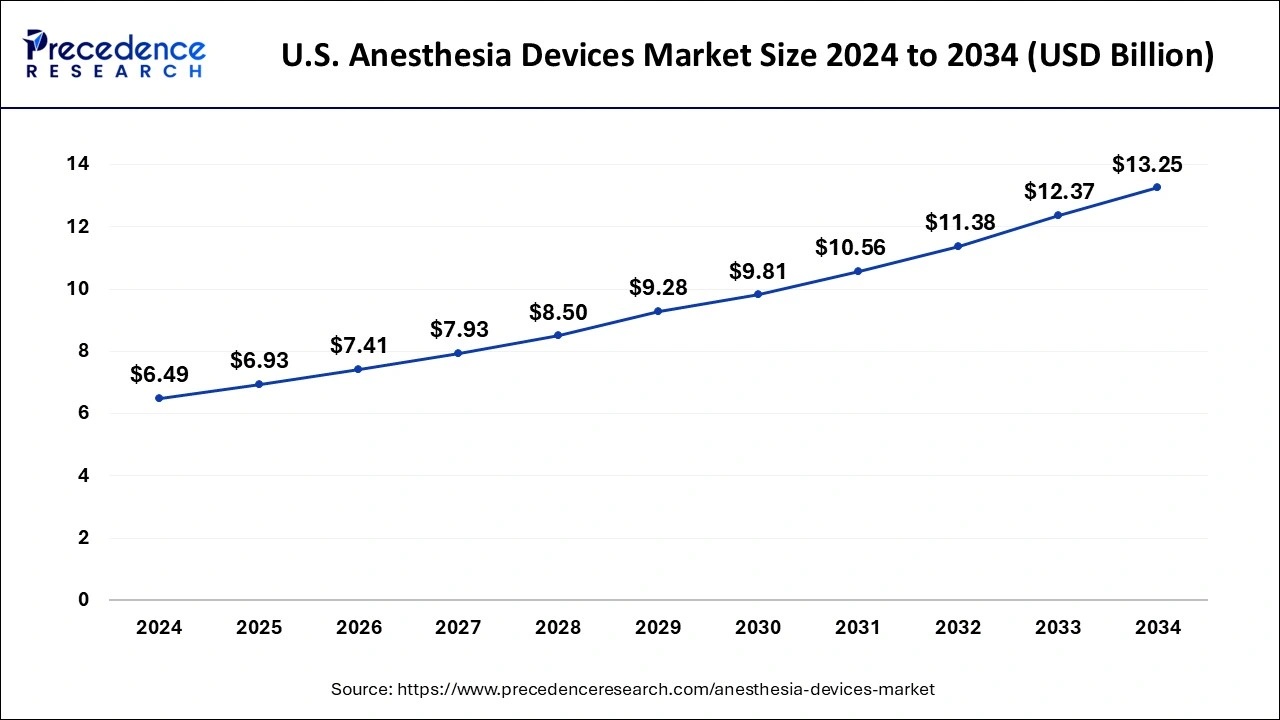
Growth is being supported by rising surgical procedure volumes, expansion of ambulatory service centers, increasing demand for patient monitoring, and continuous improvements in anesthesia workstations and delivery systems.
Download a Sample Report: https://www.precedenceresearch.com/sample/8517
Why Anesthesia Devices Are Becoming More Important
Anesthesia devices play an important role throughout the perioperative process. Anesthesia delivery machines, ventilators, vaporizers, breathing circuits, airway devices, and monitoring systems help healthcare professionals maintain patient safety during procedures.
The growing number of cardiovascular, neurological, orthopedic, ophthalmic, gastrointestinal, and other surgeries is creating consistent demand for anesthesia equipment.
Healthcare providers are also upgrading older systems with connected and digitally enabled equipment that can integrate anesthesia delivery with patient monitoring and hospital information systems.
This shift is particularly important as healthcare organizations aim to improve operating room efficiency while maintaining high standards of patient safety.
AI Is Bringing More Intelligence Into Anesthesia Care
Artificial intelligence is becoming an important technology in the development of next-generation anesthesia devices.
AI-powered systems can continuously analyze physiological information such as oxygen saturation, blood pressure, respiratory rate, heart rate, and other patient parameters.
Instead of simply displaying measurements, intelligent systems can identify unusual patterns and provide alerts when a patient’s condition may require attention.
Machine learning can also support predictive monitoring by analyzing previous patient data and identifying patterns associated with complications.
For manufacturers, AI is creating opportunities to develop anesthesia workstations and monitoring technologies that provide more automated decision support while reducing the workload on clinical staff.
Key Trends Shaping the U.S. Anesthesia Devices Sector
Anesthesia Delivery Machines Continue to Lead
Anesthesia delivery machines accounted for the largest product share in 2025.
Modern workstations combine anesthesia gas delivery, ventilation, airway management, and patient monitoring into integrated systems.
Large hospitals are increasingly investing in advanced operating rooms where integrated anesthesia systems can communicate with other perioperative technologies.
Disposables and Accessories Are Growing Quickly
The anesthesia disposables and accessories segment is expected to grow at the fastest rate.
Every surgical procedure can require products such as breathing circuits, masks, filters, endotracheal tubes, laryngeal masks, and other airway management accessories.
Unlike capital equipment, many of these products are used repeatedly, creating recurring demand across hospitals, ambulatory service centers, and clinics.
General Anesthesia Remains the Leading Type
General anesthesia held the largest share in 2025 because it is widely used in complex cardiovascular, neurological, orthopedic, oncological, transplant, and other major procedures.
Academic medical centers and large hospitals perform high-acuity procedures that frequently require comprehensive anesthesia systems and advanced monitoring.
At the same time, local anesthesia is expected to grow rapidly as more procedures move into outpatient and ambulatory settings.
Ophthalmology Is Becoming an Important Growth Area
Cardiology currently represents the leading application segment.
However, ophthalmology is expected to grow at the fastest pace as the number of outpatient cataract, glaucoma, retinal, and other eye procedures continues to rise.
Many ophthalmic procedures involve sedation or anesthesia support, creating additional demand for compact monitoring and anesthesia technologies designed for outpatient environments.
How Leading Companies Are Positioning
The U.S. anesthesia devices landscape includes major healthcare technology companies and specialized anesthesia equipment manufacturers competing through product innovation, digital integration, monitoring capabilities, and clinical partnerships.
GE HealthCare is one of the leading providers of anesthesia workstations and patient monitoring technologies. Its focus on connected care, digital workflows, and advanced monitoring is helping integrate anesthesia systems into modern operating rooms.
Dräger has extensive expertise in anesthesia workstations, ventilators, and perioperative technologies. The company is focusing on integrated platforms designed to support clinicians throughout anesthesia delivery and patient monitoring.
Philips combines patient monitoring, connected healthcare, and clinical informatics capabilities. Its technologies support hospitals seeking greater visibility across perioperative and critical care environments.
Mindray offers anesthesia systems, patient monitoring devices, and other hospital technologies. The company competes through broad product portfolios and cost-effective solutions for healthcare facilities.
Medtronic participates across respiratory care, patient monitoring, and surgical technologies. Its broader presence in operating room and procedural care provides opportunities to integrate anesthesia-related solutions with other medical technologies.
Masimo is strongly positioned in advanced patient monitoring. Its sensor and monitoring technologies provide opportunities for continuous physiological assessment during and after surgical procedures.
Getinge provides operating room, critical care, and anesthesia-related technologies while focusing on integrated healthcare environments and workflow efficiency.
Competition is increasingly shaped by connectivity, monitoring accuracy, interoperability, AI capabilities, cybersecurity, ease of use, and the ability to integrate equipment into broader digital hospital ecosystems.
Segment Highlights
Therapeutic Anesthesia Delivery Remains Central to Care
Anesthesia delivery machines lead the product category because accurate delivery of anesthetic gases and respiratory support remains essential during surgery.
Advanced workstations increasingly include integrated ventilators, monitoring interfaces, automated controls, and digital connectivity.
Disposable Products Create Recurring Demand
Accessories and disposable products provide an important recurring revenue stream because airway and breathing products are needed across surgical procedures.
Demand is expected to remain strong as surgical volumes increase across hospitals and ambulatory settings.
General Anesthesia Leads, While Local Anesthesia Expands
General anesthesia remains the dominant type because of its widespread use in complex procedures.
Local anesthesia is gaining momentum as healthcare providers perform more minor and outpatient procedures that can reduce recovery time and support faster patient discharge.
Hospitals Remain the Largest End User
Hospitals accounted for the largest share in 2025.
Large healthcare systems conduct a wide range of complex surgeries and require sophisticated anesthesia workstations, ventilators, monitoring technologies, and airway management systems.
However, ambulatory service centers are expected to grow rapidly as healthcare systems continue shifting suitable procedures from inpatient hospitals to outpatient facilities.
California Is a Major Healthcare Technology Hub
California is an important state for anesthesia device adoption because of its large healthcare infrastructure, substantial population, and concentration of hospitals and specialty centers.
The state has a strong presence of healthcare technology companies, academic medical centers, research institutions, and advanced surgical facilities.
The continued expansion of outpatient surgery, cardiovascular care, orthopedic procedures, and specialty healthcare supports demand for anesthesia equipment.
California’s technology ecosystem also creates opportunities for digital and AI-enabled medical technologies to move from development into clinical settings.
Texas Is Emerging as a Strong Growth Center
Texas is becoming increasingly important due to population growth, healthcare infrastructure development, and expansion of specialty treatment centers.
New hospitals, ambulatory surgical centers, cardiovascular facilities, and orthopedic networks are increasing demand for modern anesthesia equipment.
The state’s large healthcare ecosystem also creates opportunities for manufacturers offering connected systems and advanced operating room technologies.
The Anesthesia Devices Value Chain
The anesthesia device value chain starts with specialized components and medical-grade materials.
Raw Material and Electronic Components
Manufacturers require medical-grade plastics, sensors, valves, semiconductors, circuit boards, and precision components.
Companies such as TE Connectivity, Honeywell, Amphenol, Molex, and DuPont contribute to the supply of specialized components.
Device Manufacturing and System Integration
Companies then assemble anesthesia workstations, ventilators, vaporizers, and patient monitoring systems.
Major participants include GE HealthCare, Dräger, Philips, Mindray, and Getinge.
Distribution and Healthcare Procurement
Finished products reach hospitals, clinics, and ambulatory facilities through direct sales, distributors, and healthcare procurement networks.
Companies such as Cardinal Health, Medline Industries, McKesson, and Owens & Minor support medical product distribution.
Clinical Deployment and Aftermarket Services
Once installed, anesthesia systems require maintenance, software updates, technical support, calibration, and replacement components.
Aftermarket services therefore remain an important part of the overall device ecosystem.
Patient Safety and Regulatory Compliance Remain Critical
Anesthesia equipment directly affects patient safety, making reliability and regulatory compliance essential.
Manufacturers must meet strict requirements related to device performance, electrical safety, software functionality, ventilation, drug delivery, and monitoring accuracy.
Recent corrective actions involving anesthesia workstations have also encouraged healthcare organizations to review aging equipment and upgrade systems where necessary.
As devices become more connected, cybersecurity is becoming another major concern. Manufacturers must protect connected systems against unauthorized access while maintaining reliable operation during critical procedures.
Recent Industry Development
In November 2025, GE HealthCare introduced the Carestation 850 anesthesia delivery system, designed around evolving clinical and operational requirements with customizable tools and a space-efficient footprint. The device was awaiting FDA 510(k) clearance at the time of the announcement.
The development reflects the broader movement toward more flexible, digitally enabled, and space-efficient anesthesia systems for modern operating rooms.
What Should Healthcare Companies Watch?
Hospitals, medical device manufacturers, investors, and healthcare technology providers should closely monitor:
- AI-enabled anesthesia workstations
- Advanced patient monitoring
- Portable anesthesia systems
- Airway management technologies
- Disposable anesthesia accessories
- Ambulatory surgery growth
- Connected operating rooms
- Remote patient monitoring
- Digital anesthesia records
- Medical device cybersecurity
What Comes Next?
The U.S. anesthesia devices landscape is moving toward more connected, intelligent, and patient-focused systems.
Anesthesia workstations will increasingly combine delivery, ventilation, monitoring, and digital connectivity within a single platform.
AI is expected to add another layer of intelligence by helping clinicians interpret real-time physiological information, identify abnormal patterns, and support faster decision-making.
At the same time, the growth of ambulatory surgery centers will encourage demand for compact and efficient anesthesia technologies that can support shorter procedures and faster patient recovery.
The biggest opportunity is not simply developing better anesthesia machines. It is creating integrated perioperative systems that combine reliable anesthesia delivery, intelligent monitoring, digital connectivity, and safer clinical workflows.
As surgical volumes continue to increase across the United States, advanced anesthesia devices will remain an important part of modern operating room infrastructure.
Buy this report: https://www.precedenceresearch.com/checkout/8517
About Us
Healthcare Prism is a dedicated healthcare insights and outreach platform, operating as an extension of Precedence Research. We share relevant perspectives, industry developments, emerging trends, and research-driven insights across the global healthcare sector. Our content is built on the knowledge, research standards, and expertise of Precedence Research, with a focus on making healthcare information clear, accessible, and useful for industry professionals, businesses, researchers, and healthcare stakeholders. Healthcare Prism serves as a focused platform to extend the reach of Precedence Research’s healthcare insights and connect them with a broader professional audience.
You can place an order or ask any questions, please feel free to contact us at [email protected]
Quick Contact:
Europe Region: +44 778 256 0738
North America Region: +1 8044 4193 44
APAC Region: +91 9356 9282 04 and +65 31065601
Visit Our Website: Precedence Research – Advisory, Research & Reports