
Alzheimer’s disease is becoming an increasingly important healthcare concern as the global aging population continues to grow. One of the biggest changes in dementia care is the shift toward earlier and more accurate detection.
The global Alzheimer’s disease diagnostics sector was valued at USD 9.40 billion in 2025 and is projected to reach approximately USD 26.21 billion by 2035, expanding at a CAGR of 10.80% from 2026 to 2035.
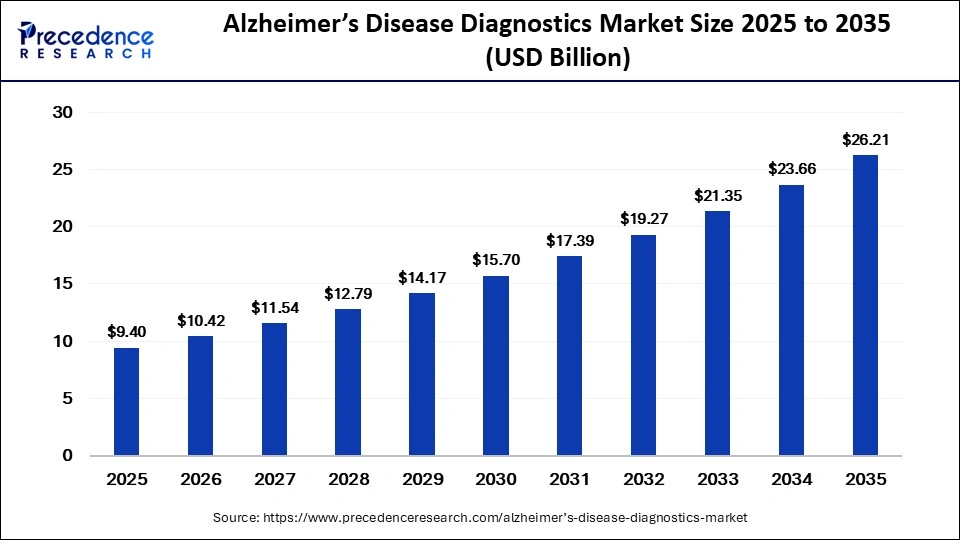
The growth is being supported by advances in brain imaging, biomarker testing, artificial intelligence, and blood-based diagnostics. These technologies are helping healthcare providers identify Alzheimer’s-related changes earlier and make diagnostic pathways more precise.
Download a Sample Report: https://www.precedenceresearch.com/sample/8427
Why Early Alzheimer’s Diagnosis Matters
Alzheimer’s disease is a progressive neurological condition, and identifying cognitive changes early can support better clinical decision-making and patient management.
Traditional diagnosis often involves cognitive assessments, medical history, and brain imaging. However, healthcare is increasingly moving toward biomarker-based approaches that can identify biological changes associated with Alzheimer’s disease.
Blood-based biomarkers are receiving particular attention because they have the potential to make testing less invasive and easier to access than some traditional diagnostic procedures.
The combination of imaging, biomarkers, genetic information, and cognitive assessments can provide clinicians with a more complete understanding of an individual’s condition.
AI Is Transforming Alzheimer’s Disease Diagnostics
Artificial intelligence is becoming one of the most promising technologies in neurological diagnostics.
AI algorithms can analyze MRI and PET images to identify subtle structural and functional changes that may be difficult to detect manually. Machine learning can also process large datasets containing imaging results, biomarker information, cognitive assessments, and genetic data.
This can support earlier identification, improve diagnostic consistency, and help clinicians evaluate disease progression.
AI is also contributing to predictive analytics. By identifying patterns across large datasets, these systems can potentially support risk assessment and more personalized diagnostic pathways.
Key Trends Shaping Alzheimer’s Diagnostics
Growth of Blood-Based Biomarker Testing
Blood-based biomarker testing is one of the most important developments in Alzheimer’s diagnostics. These tests are being developed to detect biological indicators associated with amyloid and other disease-related changes.
Their less-invasive nature could make cognitive disorder screening more accessible in primary care and community settings.
Increasing Use of AI-Assisted Imaging
AI-powered imaging analysis is helping healthcare professionals examine MRI and PET scans more efficiently. As AI tools improve, they could support faster interpretation and more standardized assessments.
Expansion of Precision Neurology
The increasing focus on precision medicine is encouraging the use of biomarkers, genetic testing, and patient-specific diagnostic information. This approach can help identify patients who may benefit from particular therapies and support more individualized disease management.
Greater Focus on Early-Stage Detection
Early-stage diagnosis accounted for 40% of applications in 2025. Growing awareness among patients and healthcare professionals is increasing the emphasis on identifying cognitive changes before symptoms become more advanced.
How Leading Companies Are Positioning
Leading healthcare and diagnostics companies are investing in imaging, biomarker testing, molecular diagnostics, and digital technologies.
F. Hoffmann-La Roche Ltd. is expanding its Alzheimer’s diagnostic capabilities through advanced biomarker technologies. In May 2026, Roche announced CE Mark approval for its Elecsys pTau217 blood test, developed with Eli Lilly, supporting amyloid pathology assessment associated with Alzheimer’s disease.
Siemens Healthineers is strengthening neurological diagnosis through advanced imaging technologies, including MRI and PET-related capabilities.
GE HealthCare continues to focus on medical imaging solutions that support neurological evaluation and disease assessment.
Fujirebio is developing biomarker testing capabilities that can support research and diagnostic applications in neurodegenerative diseases.
Quanterix is contributing highly sensitive biomarker detection technologies designed to measure low concentrations of proteins associated with neurological conditions.
C2N Diagnostics is advancing blood-based Alzheimer’s testing. Its PrecivityAD platform is designed to support the detection of amyloid-related changes and earlier clinical assessment.
These developments show a broader shift from conventional assessment toward more accessible, biomarker-driven, and technology-enabled diagnostics.
Segment Highlights
Brain Imaging Remains a Leading Diagnostic Approach
Brain imaging accounted for 38% of diagnostic types in 2025, making it the leading segment. PET and MRI remain important tools for identifying structural and biological changes associated with Alzheimer’s disease.
However, biomarker testing is expected to grow at the fastest CAGR of 16% from 2026 to 2035. The growth is being driven by improvements in blood-based assays, laboratory automation, and growing interest in minimally invasive diagnostics.
AI and Digital Diagnostics Are Growing Rapidly
Imaging technologies represented 45% of technology adoption in 2025, while AI and digital diagnostics are expected to grow at the fastest rate, with an estimated 18% CAGR.
The growing use of AI-assisted imaging, predictive analytics, and digital assessment tools is helping healthcare providers manage increasing diagnostic volumes.
Hospitals Currently Lead, Laboratories Are Expanding
Hospitals accounted for 45% of end use in 2025 because they offer access to imaging systems, neurology specialists, biomarker testing, and multidisciplinary care.
Diagnostic laboratories are expected to grow at a 13% CAGR, supported by increasing demand for blood-based biomarker testing, molecular diagnostics, and automated laboratory workflows.
Above 80 Population Represents a Growing Need
The 65–80 age group accounted for 48% in 2025. However, the population above 80 years is expected to grow fastest, at a 12.5% CAGR, reflecting the increasing need for cognitive assessment and ongoing disease monitoring among older adults.
North America Leads as Asia Pacific Accelerates
North America held the largest regional share at 42% in 2025. The region benefits from advanced healthcare infrastructure, widespread use of PET and MRI systems, strong research activity, and greater access to emerging diagnostic technologies.
The U.S. remains a major center for Alzheimer’s research, biomarker development, clinical studies, and technology adoption.
Asia Pacific is expected to grow at the fastest rate, with a projected 14% CAGR from 2026 to 2035. Increasing healthcare spending, a rapidly aging population, greater awareness of cognitive disorders, and improvements in healthcare infrastructure are supporting adoption.
China is investing in neurological healthcare and diagnostic capabilities, while Japan and other countries are focusing on aging-related healthcare services and advanced diagnostics.
Europe is also experiencing notable growth through dementia research, biomarker development, specialized neurological services, and greater use of advanced imaging technologies.
Challenges in Alzheimer’s Diagnostics
Despite rapid innovation, several challenges remain.
Advanced imaging and biomarker tests can be expensive and are not equally accessible across regions. Some healthcare systems also face shortages of specialized professionals and limited infrastructure, particularly outside major urban centers.
Regulatory requirements, reimbursement limitations, diagnostic standardization, and the need to validate new biomarkers can also slow adoption.
Making advanced testing affordable and accessible will be essential for expanding early diagnosis beyond specialized healthcare facilities.
What Should Healthcare Companies Watch?
Healthcare providers, diagnostic companies, pharmaceutical firms, and investors should closely monitor:
- Blood-based Alzheimer’s biomarkers
- AI-assisted brain imaging
- Digital cognitive assessment
- Precision neurology
- Genetic and molecular testing
- Companion diagnostics
- Laboratory automation
- Early-stage screening
- Integration of diagnostics with disease-modifying therapies
What Comes Next?
The future of Alzheimer’s disease diagnostics is moving toward earlier, less-invasive, data-driven, and more personalized detection.
Brain imaging will continue to play an important role, but blood-based biomarkers, AI-assisted analysis, molecular testing, and digital diagnostics could make Alzheimer’s testing more accessible and scalable.
The larger shift is not simply about finding Alzheimer’s earlier. It is about developing a diagnostic pathway that helps clinicians understand disease biology, monitor progression, and support more personalized treatment decisions.
As diagnostics become more closely connected with emerging Alzheimer’s therapies, the ability to identify the right patient at the right stage could become increasingly important.
Buy this report: https://www.precedenceresearch.com/checkout/8427
About Us
Healthcare Prism is a dedicated healthcare insights and outreach platform, operating as an extension of Precedence Research. We share relevant perspectives, industry developments, emerging trends, and research-driven insights across the global healthcare sector. Our content is built on the knowledge, research standards, and expertise of Precedence Research, with a focus on making healthcare information clear, accessible, and useful for industry professionals, businesses, researchers, and healthcare stakeholders. Healthcare Prism serves as a focused platform to extend the reach of Precedence Research’s healthcare insights and connect them with a broader professional audience.
You can place an order or ask any questions, please feel free to contact us at [email protected]
Quick Contact:
Europe Region: +44 778 256 0738
North America Region: +1 8044 4193 44
APAC Region: +91 9356 9282 04 and +65 31065601
Visit Our Website: Precedence Research – Advisory, Research & Reports