
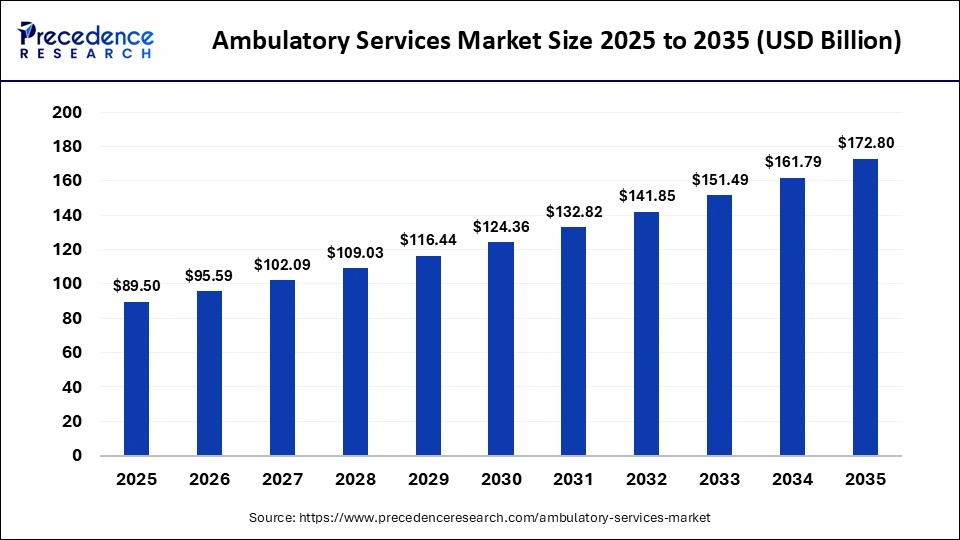
The global ambulatory services market is entering a strong growth phase as patients, providers, and insurers increasingly favor outpatient care over traditional inpatient treatment. The market size is expected to rise from USD 95.59 billion in 2026 to approximately USD 172.80 billion by 2035, expanding at a CAGR of 6.80% during the forecast period. The shift toward same-day care, advancements in minimally invasive procedures, and the growing burden of chronic diseases are among the key factors supporting market growth.
Healthcare providers are increasingly investing in outpatient clinics, ambulatory surgery centers, diagnostic facilities, and specialty care centers to reduce costs, improve patient convenience, and shorten recovery times. The growing adoption of telehealth, digital patient records, and remote monitoring solutions is further strengthening the role of ambulatory care in modern healthcare systems.
Read Also: Inpatient Services Market
Quick Insights
- The global ambulatory services market was valued at USD 89.50 billion in 2025 and is expected to reach USD 172.80 billion by 2035.
- North America led the market with a 35% share in 2025 due to advanced healthcare infrastructure and strong insurance coverage.
- Asia Pacific is projected to witness the fastest growth, with a CAGR of 8.0% through 2035.
- Surgical services dominated the market with a 55% share in 2025 because of increasing minimally invasive and outpatient procedures.
- Orthopedic surgery emerged as the leading specialization, accounting for 25% of the market in 2025.
- Private ownership accounted for 60% of the market in 2025 due to greater operational flexibility and faster technology adoption.
- Private insurance represented the largest payer segment with a 40% market share in 2025.
How is Artificial Intelligence Transforming the Ambulatory Services Market?
Artificial intelligence is reshaping ambulatory care by making outpatient diagnosis, scheduling, and treatment more efficient. AI-powered clinical decision tools are helping physicians identify risks earlier, reduce diagnostic errors, and personalize treatment plans for patients in outpatient settings.
AI is also improving workflow management in ambulatory surgery centers and clinics. Predictive analytics can optimize appointment scheduling, minimize patient wait times, and improve resource allocation. Combined with telehealth and remote monitoring technologies, AI is enabling more accessible and efficient outpatient care delivery.
What are the Major Growth Factors Driving the Ambulatory Services Market?
The ambulatory services market is expanding due to a combination of patient preferences, technology, and healthcare cost pressures.
- Rising preference for outpatient procedures with shorter recovery times
- Growing adoption of minimally invasive surgical techniques
- Increasing burden of chronic diseases requiring regular monitoring
- Expanding elderly population needing continuous outpatient care
- Stronger reimbursement support for ambulatory procedures
- Advancements in portable diagnostics, imaging, and telemedicine
- Higher focus on preventive healthcare and early diagnosis
These trends are encouraging healthcare systems to move more treatments out of hospitals and into outpatient settings.
Why is Same-Day Healthcare Becoming the Future of Medical Services?
Same-day care is becoming increasingly popular because it offers greater convenience and lower costs compared to inpatient hospitalization. Patients prefer outpatient treatment because it reduces the time spent in hospitals and allows them to recover at home.
Healthcare providers also benefit because ambulatory care reduces infrastructure costs and helps manage hospital overcrowding. As minimally invasive technologies continue to improve, more procedures that once required overnight stays can now be safely completed in ambulatory settings.
Which Specialties are Creating the Biggest Opportunities in the Market?
Orthopedic surgery remains the leading specialty due to the rising number of sports injuries, arthritis cases, and musculoskeletal disorders. Minimally invasive orthopedic procedures are increasingly being performed in ambulatory surgery centers because they are faster, more affordable, and easier for patients to recover from.
Cardiology is also emerging as a major growth segment as more catheter-based procedures, angioplasties, and diagnostic tests are performed outside hospitals. Gastroenterology is expected to grow rapidly as demand rises for outpatient colonoscopies, endoscopies, and digestive disorder treatments.
Segment Analysis
Service Type Analysis
Surgical services dominated the ambulatory services market with a 55% share in 2025. Increasing adoption of outpatient surgeries, particularly minimally invasive procedures, continues to drive demand in this segment.
Diagnostic and therapeutic services are expected to register the fastest growth because of the increasing importance of early disease detection, preventive care, and personalized medicine. Pain management services are also gaining traction due to the rising prevalence of chronic pain conditions such as arthritis and back pain.
Specialization Analysis
Orthopedic surgery held the largest share of the market in 2025 due to increasing cases of musculoskeletal disorders and sports injuries. Cardiology is expected to grow strongly as outpatient cardiac interventions become more common.
Gastroenterology is anticipated to witness one of the fastest growth rates because of rising demand for endoscopy, colonoscopy, and digestive disorder management in ambulatory settings.
Ownership Analysis
Private ownership dominated the market with a 60% share in 2025. Private facilities have greater flexibility to adopt new technologies, expand service offerings, and deliver more personalized care.
Non-profit ownership is expected to register the fastest growth as governments and healthcare organizations increasingly support affordable care delivery for underserved populations. Public ownership also continues to play an important role in expanding access to ambulatory services.
Payer Analysis
Private insurance represented the largest payer segment with a 40% market share in 2025. Patients with private coverage often benefit from faster access to advanced outpatient services and wider provider networks.
Public insurance programs such as Medicare and Medicaid remain essential for elderly and low-income populations, supporting demand for ambulatory surgeries and treatments.
Regional Analysis
Why Did North America Dominate the Ambulatory Services Market?
North America accounted for 35% of the global market in 2025 due to its advanced healthcare systems, strong insurance coverage, and widespread adoption of ambulatory surgery centers. The region also benefits from an aging population, high prevalence of chronic diseases, and supportive government policies promoting outpatient care.
The U.S. remains the largest contributor within North America because of its mature outpatient care ecosystem, high healthcare spending, and strong technology adoption.
Why is Asia Pacific Growing So Rapidly?
Asia Pacific is projected to grow at the fastest CAGR of 8.0% during the forecast period. Rising healthcare investments, growing urban populations, and improving access to outpatient care are key factors behind this expansion.
Countries such as India, China, and Japan are investing heavily in ambulatory clinics, diagnostic centers, and telehealth infrastructure. Demand for affordable and accessible care is also encouraging providers to expand outpatient services in the region.
Europe: The Second-Largest Market
Europe held a 30% share of the market in 2025, supported by strong public healthcare systems and government efforts to reduce hospital costs. Countries such as Germany, France, and the UK are increasingly shifting procedures to outpatient settings to improve efficiency and reduce waiting times.
What are the Biggest Challenges Facing the Market?
Despite strong growth potential, the ambulatory services market faces several challenges. Diagnostic errors remain a significant concern because patients in outpatient settings may receive limited follow-up care or fragmented medical information.
High treatment costs, particularly for uninsured patients, can also limit access to ambulatory services. Additionally, some complex procedures still require hospital-based care, restricting the expansion of outpatient treatment options.
Case Study: Outpatient Orthopedic Surgery Gains Popularity
Orthopedic surgery has emerged as one of the most successful outpatient specialties due to advances in minimally invasive techniques and rehabilitation methods. Knee arthroscopy, joint repair, and sports injury procedures are increasingly performed in ambulatory surgery centers because patients can recover more quickly and avoid lengthy hospital stays.
Healthcare providers are also seeing better operational efficiency and lower treatment costs, making outpatient orthopedic services an attractive option for both patients and insurers.
Ambulatory Surgical Center Market Companies
- HCA Healthcare, Inc.
- Tenet Healthcare Corporation
- Mednax, Inc.
- Surgical Care Affiliates (SCA)
- UnitedHealth Group (Optum Health)
- AmSurg Corporation (Envision Healthcare)
- Ramsay Healthcare
- DaVita Inc.
- MediPost, Inc.
- Fresenius Medical Care
- USPI (Universal Surgical Partners, Inc.)
- Northwell Health
- Community Health Systems, Inc.
- Regents Health Services
- Alcon, Inc.
Segments Covered in the Report
By Service Type
- Surgical Services
- Diagnostic and Therapeutic Services
- Pain Management Services
- Other Medical Services
By Specialization
- Orthopedic Surgery
- Cardiology
- Ophthalmology
- Plastic Surgery
- Gastroenterology
- Urology
- Other Specializations
By Ownership
- Private Ownership
- Public Ownership
- Non-profit Ownership
By Payer
- Private Insurance
- Public Insurance (Medicare/Medicaid)
- Out-of-Pocket
By Region
- North America
- Latin America
- Europe
- Asia-pacific
- Middle and East Africa
Get Sample Copy: https://www.precedenceresearch.com/sample/8311
For inquiries regarding discounts, bulk purchases, or customization requests, please contact us at [email protected]