
The US medical devices market is experiencing robust growth, supported by rapid technological advancements, increasing healthcare expenditure, and rising demand for minimally invasive treatments. Expanding adoption of digital healthcare solutions and strong investment in medical innovation are expected to create significant growth opportunities through 2035.
What is the US Medical Devices Market Size?
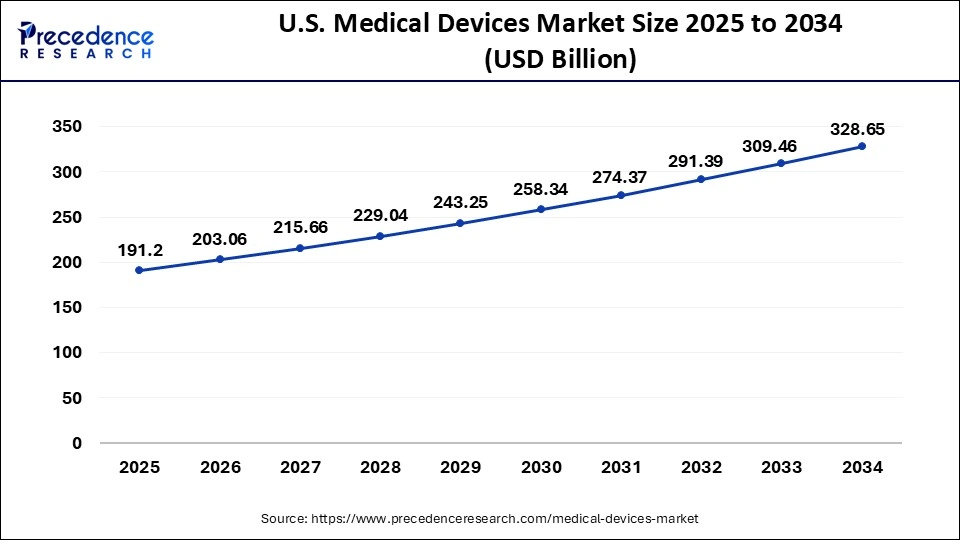
The US medical devices market size accounted for USD 191.20 billion in 2025 and is predicted to increase from USD 203.06 billion in 2026 to approximately USD 346.19 billion by 2035, expanding at a CAGR of 6.20% from 2026 to 2035. The market growth is attributed to increasing adoption of advanced medical technologies, expanding healthcare infrastructure, and continuous innovation in diagnostic and therapeutic devices.
Market Overview
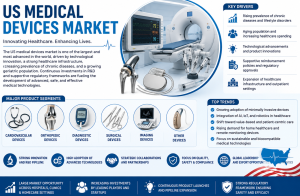
The United States represents one of the largest and most technologically advanced medical device markets in the world. The industry encompasses a wide range of products, including diagnostic imaging systems, cardiovascular devices, orthopedic implants, surgical instruments, patient monitoring equipment, and wearable healthcare technologies. Continuous innovation and strong healthcare infrastructure have positioned the country as a global leader in medical technology development.
Rising prevalence of chronic diseases such as cardiovascular disorders, diabetes, obesity, and cancer has increased the need for advanced diagnostic and therapeutic solutions. Healthcare providers are increasingly adopting sophisticated medical devices that enable early diagnosis, personalized treatment, and improved patient outcomes. The growing aging population is also contributing to sustained demand for healthcare products and services.
The regulatory environment in the United States plays a vital role in shaping the market. The Food and Drug Administration (FDA) continues to support innovation through streamlined approval pathways for breakthrough technologies while maintaining stringent safety standards. These regulations encourage manufacturers to focus on quality, reliability, and clinical effectiveness.
Another important factor driving the market is the growing preference for minimally invasive procedures. Patients and healthcare providers are seeking treatments that reduce recovery time, lower hospitalization costs, and improve surgical precision. Robotic-assisted surgery systems, catheter-based interventions, and advanced imaging devices are gaining widespread acceptance across hospitals and specialty clinics.
The future outlook for the US medical devices market remains promising. Continued investments in research and development, expansion of home healthcare services, and increasing adoption of connected medical devices are expected to support long-term growth. Advances in digital health technologies and precision medicine are likely to redefine patient care and create new opportunities across the healthcare ecosystem.
AI Impact
Artificial intelligence is transforming the US medical devices industry by enabling smarter diagnostics, automated workflows, and improved clinical decision-making. AI-powered imaging systems are helping physicians detect diseases earlier and achieve greater diagnostic accuracy. Technologies based on deep learning are increasingly being integrated into radiology, cardiology, pathology, and oncology applications.
Machine learning algorithms are improving predictive analytics by analyzing large volumes of patient data. These technologies help healthcare providers identify potential complications, monitor disease progression, and personalize treatment plans. Predictive healthcare is becoming an important area of innovation for medical device manufacturers.
AI is also enhancing robotic surgery systems and remote patient monitoring devices. Intelligent algorithms assist surgeons with greater precision during complex procedures while wearable devices equipped with AI capabilities provide continuous health monitoring and real-time alerts. These innovations are improving patient outcomes and reducing healthcare costs.
Manufacturers are utilizing artificial intelligence to optimize supply chain operations, accelerate product development, and strengthen quality control processes. AI-driven automation is reducing production inefficiencies and enabling faster commercialization of advanced medical technologies.
Market Trends
- Rising adoption of minimally invasive surgical procedures.
- Increasing integration of artificial intelligence in diagnostic devices.
- Strong demand for wearable medical technologies and remote monitoring solutions.
- Expansion of telehealth and connected healthcare ecosystems.
- Growing investments in robotic-assisted surgery systems.
- Increasing use of cloud-based healthcare platforms and digital health technologies.
- Rising focus on personalized medicine and precision healthcare.
- Development of smart implants and biosensor technologies.
- Strong emphasis on cybersecurity and data privacy for connected devices.
- Increasing collaborations between medical device manufacturers and software companies.
Market Scope
| Report Coverage | Details |
| Market Size in 2025 | USD 191.20 Billion |
| Market Size in 2026 | USD 203.06 Billion |
| Market Size by 2035 | USD 346.19 Billion |
| Market Growth Rate from 2026 to 2035 | CAGR of 6.20% |
| Base Year | 2025 |
| Forecast Period | 2026 to 2035 |
| Segments Covered | Product, End User, and Sales Channel |
Segment Insights
By Product Type
Diagnostic imaging devices account for a substantial share of the US medical devices market due to their critical role in disease detection and treatment planning. Advanced imaging systems, including MRI, CT, ultrasound, and molecular imaging technologies, continue to witness strong demand across healthcare facilities.
Cardiovascular devices remain one of the most important segments owing to the increasing burden of heart diseases and the growing number of interventional procedures. Continuous innovation in stents, pacemakers, and catheter-based technologies is supporting segment growth.
Orthopedic devices are experiencing steady expansion as the aging population drives demand for joint replacement surgeries and trauma care products. Technological improvements in implant materials and robotic-assisted orthopedic procedures are enhancing treatment outcomes.
Patient monitoring devices are witnessing rapid growth due to increasing demand for home healthcare and chronic disease management solutions. Wearable sensors and connected monitoring systems are becoming essential components of modern healthcare delivery.
Competitive Landscape
Competition within the US medical devices market is characterized by continuous technological innovation and strong investments in research and development. Companies are focusing on introducing next-generation devices that improve clinical efficiency and patient outcomes.
Strategic collaborations between healthcare providers, technology firms, and medical device manufacturers are accelerating innovation. Partnerships involving artificial intelligence, robotics, and digital health platforms are reshaping the competitive environment.
Mergers and acquisitions continue to play a major role in strengthening product portfolios and expanding market presence. Companies are investing in manufacturing capabilities and geographic expansion to meet growing demand for advanced healthcare solutions.
Sustainability and regulatory compliance are becoming increasingly important. Manufacturers are emphasizing environmentally responsible production practices while ensuring product quality and patient safety standards remain uncompromised.
Leading Companies in the Market
- Medtronic plc
- Johnson & Johnson MedTech
- Abbott Laboratories
- GE HealthCare
- Boston Scientific Corporation
- Stryker Corporation
- Becton, Dickinson and Company
- Edwards Lifesciences Corporation
- Zimmer Biomet Holdings Inc.
- Baxter International Inc.
- Siemens Healthineers
- Philips Healthcare
- Intuitive Surgical Inc.
- ResMed Inc.
- Terumo Corporation
Get Sample Link : https://www.precedenceresearch.com/sample/8503
U.S. Medical Devices Market Value Chain Analysis
- Raw Material & Electronic Component Sourcing
Medical device production begins with medical-grade polymers, metals, semiconductors, sensors, and electronic components.
Key Players: DuPont, 3M, TE Connectivity, Amphenol, Texas Instruments, Analog Devices
- Component Manufacturing & Device Production
Manufacturers convert raw materials into diagnostic, therapeutic, monitoring, and surgical device components.
Key Players: Medtronic, Abbott, Boston Scientific, Stryker, Becton Dickinson (BD), Baxter International
- Device Assembly, Testing & Regulatory Compliance
Companies assemble finished devices and conduct quality, safety, sterilization, and regulatory validation processes.
Key Players: Philips, GE HealthCare, Siemens Healthineers, Edwards Lifesciences, Zimmer Biomet, Olympus Corporation
- Distribution to Healthcare Providers & End Users
Finished devices move through distributors and dealers to hospitals, clinics, laboratories, and home healthcare settings.
Key Players: Cardinal Health, McKesson, Owens & Minor, Medline Industries, Henry Schein, Cencora
Recent Developments
- In June 2026, Medtronic announced key milestones for its Hugo robotic-assisted surgery (RAS) system, submitting 510(k) clearances for general surgery, gynecologic surgery, and LigaSure RAS instruments. They completed enrollment in a Gynecology IDE clinical study and received clearance for ProGrip Advanced mesh for robotic-assisted hernia repair.
- In June 2026, Johnson & Johnson announced a USD 1 billion investment in Jacksonville, Florida, to enhance its Vision operations. This includes building a new distribution facility and advancing manufacturing capacities for ACUVUE contact lenses, reinforcing their commitment to improving eye health for over 40 million patients globally.
Also Read Our Latest Article : Tylosin Market