
The U.S. electron microscopy market is experiencing robust growth driven by increasing investments in life sciences research, semiconductor manufacturing, nanotechnology, and materials science. Continuous technological advancements and the integration of AI-powered imaging solutions are further accelerating market expansion.
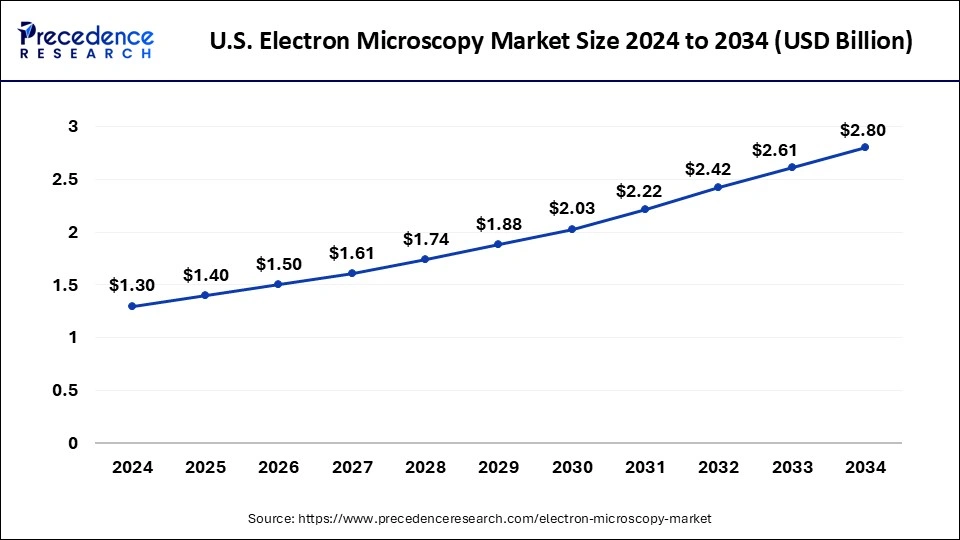
US Electron Microscopy Market Size and Forecast 2026 to 2035
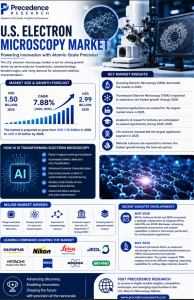
The US electron microscopy market size was valued at USD 1.40 billion in 2025 and is predicted to increase from USD 1.50 billion in 2026 to approximately USD 2.99 billion by 2035, expanding at a CAGR of 7.88% from 2026 to 2035. The market growth is attributed to rising semiconductor investments, expanding nanotechnology research, and increasing demand for atomic-scale characterization capabilities.
Market Highlights
- Based on type, the scanning electron microscopy (SEM) segment dominated the U.S. electron microscopy market in 2025, driven by its widespread adoption across industrial inspection, materials characterization, and life science research applications.
- The transmission electron microscopy (TEM) segment is anticipated to witness the fastest growth during the forecast period, supported by increasing demand for high-resolution imaging and advancements in nanotechnology and semiconductor research.
- By end user, the industries segment accounted for the largest share of the market in 2025, owing to the growing use of electron microscopy in sectors such as electronics, automotive, and pharmaceuticals for quality control and failure analysis.
- Academic and research institutes are expected to register notable growth between 2026 and 2035, fueled by rising investments in scientific research and the expanding use of advanced imaging technologies in universities and research centers.
- In terms of application, the life sciences segment held the highest market share, reflecting the increasing use of electron microscopy in biological research, disease diagnosis, and drug development activities.
- The material science segment is projected to grow at the fastest rate during the forecast period, driven by increasing research in nanomaterials, advanced composites, and next-generation semiconductor materials.
What is the Current Market Overview of the US Electron Microscopy Market?
The U.S. electron microscopy market is witnessing significant growth due to the rising demand for high-resolution imaging technologies across healthcare, life sciences, semiconductors, and advanced materials industries. Electron microscopes play a critical role in analyzing cellular structures, nanoparticles, and complex materials with exceptional precision.
Increasing research activities, government funding, and investments in biotechnology and nanotechnology are contributing to market expansion. Moreover, the growing focus on drug discovery and semiconductor innovation is expected to support long-term growth.
What are the Major Trends Shaping the US Electron Microscopy Market?
Several trends are influencing the development of the market:
Rising Adoption in Life Sciences Research
Electron microscopy is increasingly being utilized for cellular analysis, structural biology, and disease research, supporting advancements in personalized medicine and biotechnology.
Expanding Semiconductor Industry
Growing demand for advanced chips and miniaturized electronics is driving the use of electron microscopes for failure analysis, quality control, and nanostructure characterization.
Development of Cryo-Electron Microscopy
Cryo-electron microscopy (Cryo-EM) is gaining traction due to its ability to provide high-resolution images of biological molecules, enabling breakthroughs in drug development and protein research.
Increasing Investments in Nanotechnology
Researchers are leveraging electron microscopy to study nanomaterials and develop innovative products for healthcare, energy, and electronics applications.
Technological Advancements in Imaging Systems
Manufacturers are introducing faster, more automated, and higher-resolution microscopy systems to improve efficiency and analytical capabilities.
How is Artificial Intelligence Impacting the US Electron Microscopy Market?
Artificial intelligence is revolutionizing electron microscopy by enhancing image acquisition, analysis, and automation capabilities.
AI technologies are being used to:
- Improve image quality and resolution.
- Automate sample analysis and defect detection.
- Accelerate drug discovery and materials research.
- Reduce imaging time and operational complexity.
- Enhance data interpretation and workflow efficiency.
As AI-powered microscopy solutions continue to evolve, they are expected to significantly improve research productivity and diagnostic accuracy.
Market Scope
| Report Coverage | Details |
| Market Size in 2026 | USD 1.40 Billion |
| Market Size in 2026 | USD 1.50 Billion |
| Market Size by 2035 | USD 2.99 Billion |
| Growth Rate from 2026 to 2035 | CAGR of 7.88% |
| Base Year | 2025 |
| Forecast Period | 2026 to 2035 |
| Segments Covered | Type, End User, and Application |
Opportunity
Surging Adoption of Cryo-Electron Microscopy in Life Science Research
The surging adoption of cryo-electron microscopy in life science research is likely to create immense opportunities for the market across biomedical institutions. As cryo-electron microscopy (cryoEM) becomes increasingly adopted in life science research, there will be a growing demand for advanced imaging platforms in biomedical institutions.
Cryo-EM is used to study proteins, viruses, cellular structure, and molecular interactions at almost atomic resolution. Investment in next-generation microscopy infrastructure is validated by continued strong interest in precision medicine and biologics research.
Segment Insights
By Type
The Scanning Electron Microscopy Segment Dominated the Market in 2025
The scanning electron microscopy segment dominated the U.S. electron microscopy market in 2025 due to the widespread application of technologies for surface characterization across various industries such as semiconductors, materials science, aerospace, and industrial manufacturing. Unlike platforms used for TEM, SEM has the advantages of low operational requirements, quick sample analysis, and high-resolution imaging.
The rising investment in domestic semiconductor manufacturing plants also continued to fuel advanced inspection and metrology solutions. Additionally, the research institutes increased the use of electron microscopy in various projects on nanotechnology, metallurgy, battery materials, and additive manufacturing.
The transmission electron microscopy segment is expected to grow at the fastest CAGR from 2026 to 2035, driven by growing demand for atomic-scale imaging and ultra-high-resolution characterization capabilities. Researchers can now view the crystal structure, interfaces, defects, and the behavior of nanoscale materials with unparalleled detail using TEM systems.
Thermo Fisher Scientific is expanding access to co-staining, structural biology research, and AI-driven microscopy workflows with the launch of the Talos 12 TEM and the Krios 5 Cryo-TEM in 2025. Furthermore, these technological advances and growing research requirements are estimated to strengthen the segment’s position throughout the forecast period.
By End User
The Industries Segment Dominated the Market in 2025
The industries segment dominated the U.S. electron microscopy market in 2025 due to the broad deployment of microscopy systems across multiple commercial sectors. Electron microscopy is being used in material manufacturing for the characterization of microstructures, assisting in developing new products faster and enhancing the performance of old ones.
The academic and research institutes segment is expected to grow at the highest CAGR between 2026 and 2035, supported by growing investment in emerging industries such as nanotechnology, quantum research, and structural biology, and research in advanced materials. Electron microscopy is being used more and more in universities and research centers to learn about the atomic-level properties and structures of materials and the mechanisms of biological activity.
By Application
The Life Science Segment Dominated the Market in 2025
The life science segment dominated the U.S. electron microscopy market in 2025 due to the expanding role of structural biology in modern healthcare research. Precision medicine and biologics research are driving the need for high-performance imaging platforms across research institutions. Additionally, the increasing adoption of electron microscopy in structural biology, cellular research, virology, and drug discovery applications further facilitates the segment growth in the coming years.
The material science segment is expected to grow at a significant CAGR between 2026 and 2035, driven by extensive use of electron microscopy for nanoscale characterization, structural analysis, and advanced materials development. Scanning electron microscopy and transmission electron microscopy are used to investigate the crystal structures, grain boundaries, defects, thin films, and nanomaterials with extraordinary accuracy and precision.
Who are the Leading Companies Operating in the US Electron Microscopy Market?
Several companies are actively involved in developing advanced electron microscopy solutions. Major players include:
- Thermo Fisher Scientific Inc.
- JEOL Ltd.
- Hitachi High-Tech Corporation
- Carl Zeiss AG
- Bruker Corporation
- Nikon Corporation
- Oxford Instruments plc
- Leica Microsystems
- Delong Instruments
- TESCAN GROUP
These companies focus on product innovation, strategic partnerships, and technological advancements to strengthen their positions in the market.
What is the Future Outlook for the US Electron Microscopy Market?
The U.S. electron microscopy market is expected to experience sustained growth, supported by advancements in cryo-electron microscopy, AI-powered imaging technologies, and increasing demand from life sciences and semiconductor industries. Continued investments in research and innovation are anticipated to create lucrative opportunities for market participants over the forecast period.
Recent Developments
- In May 2026, MVTec Software GmbH and ZEISS announced a collaboration, integrating MVTec HALCON into ZEISS Blockwise, a software platform for automated microscopy. This partnership aims to enhance measurement and analysis in electron microscopy, particularly benefiting the semiconductor industry.
- In May 2026, PicoQuant launched Solira, a new microscope for time-resolved photoluminescence (TRPL) measurements and advanced materials characterization. Solira supports various methods, including TRPL imaging and carrier diffusion mapping, and will debut at the E-MRS Spring Meeting 2026 in Strasbourg, France, from May 25-29.
Segments Covered in the Report
By Type
- Scanning Electron Microscopy (SEM)
- Transmission Electron Microscopy (TEM)
- Others
By End User
- Industries
- Academic and Research Institutes
- Others
By Application
- Lifesciences
- Material Sciences
- Semiconductors
- Nanotechnology
- Others
Get Sample Link: https://www.precedenceresearch.com/sample/8482
Also Read : US Drug Discovery Market