
The mRNA therapeutics market is rapidly transforming modern medicine by enabling the development of highly targeted and adaptable treatments. Growing demand for personalized therapies and increasing investments in biotechnology are supporting long-term market expansion.
Advances in delivery technologies, rising clinical success rates, and expanding applications beyond vaccines are expected to create significant opportunities for industry participants over the next decade.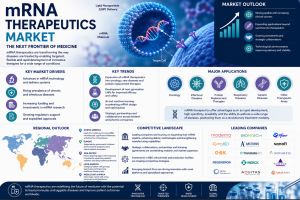
mRNA Therapeutics Market Size and Forecast 2026 to 2035
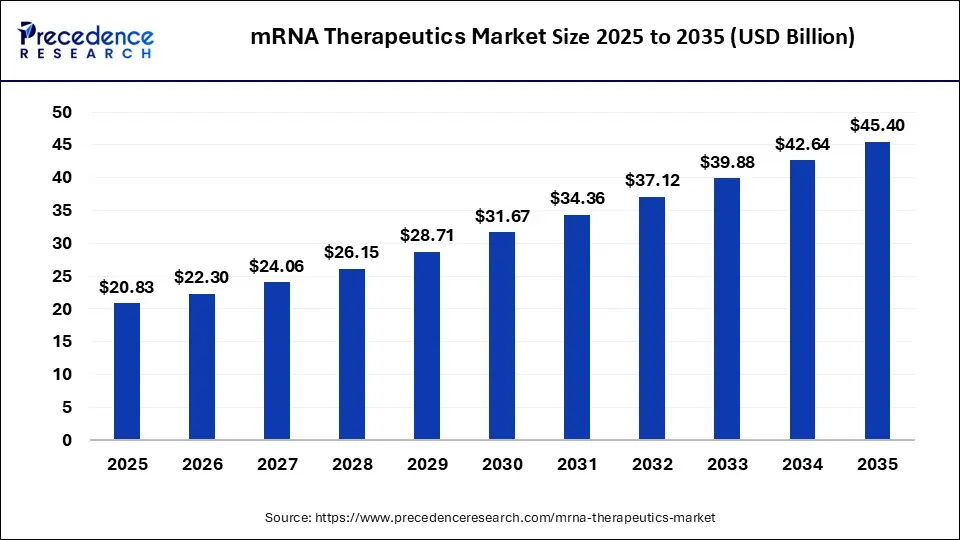
The mRNA therapeutics market size accounted for USD 20.83 billion in 2025 and is predicted to increase from USD 22.30 billion in 2026 to approximately USD 45.4 billion by 2035, expanding at a CAGR of 8.1% from 2026 to 2035.
Market Outlook
Messenger RNA (mRNA) therapeutics have emerged as one of the most promising areas of biotechnology, offering a new approach to treating diseases by instructing cells to produce specific proteins. Unlike conventional therapies, mRNA-based medicines can be designed and manufactured more rapidly, making them highly attractive for addressing infectious diseases, cancer, rare genetic disorders, and protein deficiencies.
The success of mRNA vaccines accelerated research efforts and increased confidence in the platform’s broader therapeutic potential. Pharmaceutical and biotechnology companies are now focusing on expanding mRNA applications into oncology, cardiovascular diseases, autoimmune disorders, and regenerative medicine. Improvements in lipid nanoparticle delivery systems and manufacturing processes have significantly enhanced the stability and effectiveness of mRNA-based therapies.
Growing healthcare expenditure, rising prevalence of chronic diseases, and increasing emphasis on precision medicine are fueling demand worldwide. Governments and private investors are supporting research initiatives aimed at accelerating the development of innovative RNA therapies. Strong clinical pipelines and favorable regulatory pathways are expected to strengthen the industry’s growth trajectory over the forecast period.
Despite the promising outlook, challenges related to storage requirements, delivery efficiency, manufacturing costs, and regulatory complexity remain. Continued innovation and strategic collaborations across the biotechnology ecosystem are helping overcome these barriers and expand the commercial potential of mRNA therapeutics.
AI Impact on the mRNA Therapeutics Market
Artificial intelligence is playing a pivotal role in accelerating the development of mRNA therapeutics. Machine learning algorithms are helping researchers identify optimal RNA sequences, predict protein expression patterns, and improve therapeutic performance. These capabilities are significantly reducing the time required for drug discovery and preclinical research.
AI-powered computational models are enhancing the design of lipid nanoparticle delivery systems, enabling more precise targeting and improved stability. Predictive analytics is also helping companies evaluate toxicity profiles and optimize manufacturing processes, increasing efficiency and reducing development costs.
Digital technologies are transforming clinical trials by enabling better patient selection and improving data analysis. AI-driven platforms can analyze vast genomic datasets and support the development of personalized mRNA therapies tailored to individual patient characteristics. This trend is expected to create new opportunities for precision medicine.
As biotechnology companies continue integrating artificial intelligence into research and development, the pace of innovation in mRNA therapeutics is likely to accelerate, leading to safer and more effective treatments across multiple therapeutic areas.
Key Market Trends
- Increasing expansion of mRNA therapies beyond infectious disease vaccines.
- Rising investments in oncology focused mRNA therapeutics.
- Growing use of artificial intelligence and computational biology in RNA design.
- Advances in lipid nanoparticle delivery technologies.
- Increasing collaborations between pharmaceutical and biotechnology companies.
- Rising interest in personalized and precision medicine approaches.
- Expansion of clinical pipelines targeting rare and genetic diseases.
- Growing regulatory support for innovative RNA-based medicines.
- Increasing investments in manufacturing capabilities and supply chain infrastructure.
- Development of self-amplifying mRNA platforms to improve efficacy and reduce dosage requirements.
Segment Insights
By Type
Prophylactic mRNA therapeutics account for a significant share of the market due to the success of mRNA vaccines and increasing demand for preventive healthcare solutions. Therapeutic mRNA products are expected to witness faster growth as research efforts expand into cancer immunotherapy and rare disease treatments.
By Application
Infectious diseases remain a major application area owing to the proven effectiveness of mRNA-based vaccines. Oncology is emerging as one of the fastest-growing segments, driven by increasing interest in personalized cancer therapies and growing investments in immuno-oncology research.
By Delivery Mode
Lipid nanoparticles dominate the market because they offer efficient and safe delivery of mRNA molecules. Continuous advancements in nanotechnology are enhancing delivery efficiency and enabling broader therapeutic applications.
By End User
Hospitals and specialty clinics represent a major end-user segment due to the administration of advanced therapies in clinical settings. Research institutions and biotechnology companies are also contributing significantly to market growth through ongoing innovation and clinical development activities.
Regional Analysis
North America leads the global mRNA therapeutics market owing to strong research infrastructure, significant investments in biotechnology, and the presence of major industry players. The United States continues to dominate due to extensive clinical trials, favorable regulatory frameworks, and increasing adoption of precision medicine.
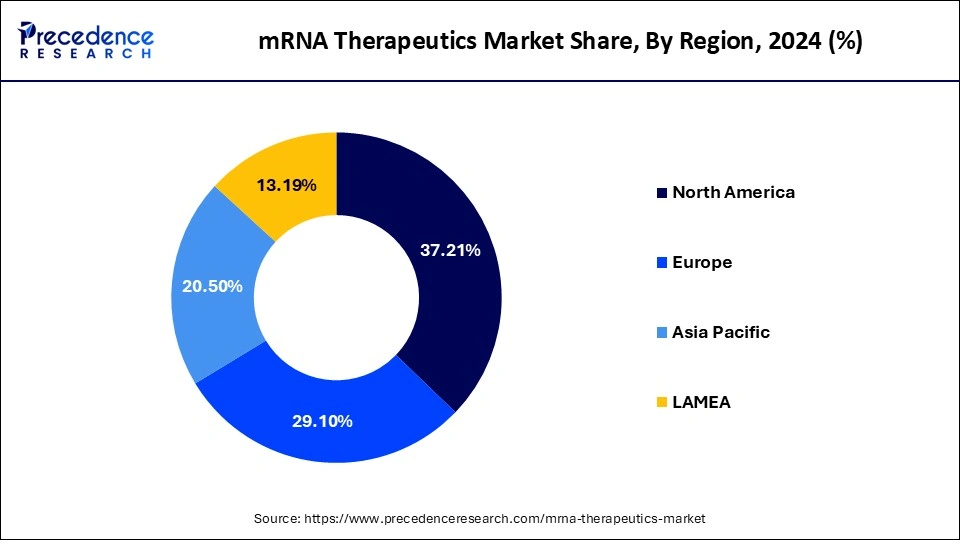
Europe holds a substantial market share supported by growing investments in life sciences and strong government backing for innovative healthcare technologies. Countries including Germany, the United Kingdom, and France are actively promoting biotechnology research and advanced therapeutics development.
Asia-Pacific is expected to register the fastest growth during the forecast period. Expanding pharmaceutical manufacturing capabilities, increasing healthcare spending, and rising investments in biotechnology are supporting market expansion. China, Japan, South Korea, and India are emerging as important hubs for RNA-based research and development.
Latin America is witnessing steady growth due to improvements in healthcare infrastructure and rising awareness regarding advanced therapeutic solutions. Brazil and Mexico are attracting investments aimed at strengthening biotechnology capabilities.
The Middle East and Africa market is gradually developing, supported by growing healthcare expenditure and increasing interest in innovative medical technologies. Governments across the Gulf countries are investing in biotechnology and precision medicine initiatives to diversify their healthcare sectors.
Competitive Landscape
Competition within the mRNA therapeutics market is characterized by continuous innovation and strong investment in research and development. Leading pharmaceutical and biotechnology companies are expanding their product pipelines to address unmet medical needs across oncology, infectious diseases, and rare disorders.
Strategic collaborations and licensing agreements have become essential for accelerating product development and strengthening manufacturing capabilities. Companies are investing heavily in advanced delivery systems and next-generation mRNA technologies to improve efficacy and broaden therapeutic applications.
Mergers and acquisitions are reshaping the competitive landscape as larger pharmaceutical companies seek access to innovative RNA platforms and specialized expertise. These activities are contributing to faster commercialization and global expansion.
The industry is also witnessing growing investment in manufacturing facilities and supply chain optimization. Companies are focusing on building scalable production capabilities to support increasing demand for mRNA-based therapies worldwide.
Leading Companies in the Market
- Moderna Inc.
- BioNTech SE
- Pfizer Inc.
- CureVac N.V.
- Arcturus Therapeutics Holdings Inc.
- Translate Bio
- Sanofi
- GlaxoSmithKline plc
- Novartis AG
- Merck & Co., Inc.
- Regeneron Pharmaceuticals Inc.
- Vertex Pharmaceuticals Incorporated
- Orna Therapeutics
- Acuitas Therapeutics
- Vaxart Inc.
Get Sample Link : https://www.precedenceresearch.com/sample/2118
Recent Developments
- BioNTech has recently supercharged its mRNA therapeutic capabilities by acquiring CureVac, a significant move that enhances its research, development, manufacturing, and commercialization strength in personalized cancer immunotherapy. This acquisition, valued at approximately $1.25 billion, consolidates BioNTech’s position in the oncology segment and unifies intellectual property, expertise, and pipeline assets. At the same time, BioNTech settled a patent dispute with CureVac and GSK through a compensation agreement that includes upfront payment and ongoing royalties, smoothing the way for future collaboration and synergy. This maneuverer not only eliminates legal hurdles but also signals BioNTech’s commitment to aggressively advancing next-gen mRNA cancer therapies.
- A scientific breakthrough emerged from a collaborative research team in Warsaw, who identified the enzyme TENT5A as a natural regulator that extends the poly (A) tail of mRNA therapeutic molecules effectively prolonging their stability and functional lifespan inside cells. This discovery is akin to Turing an hourglass upside down, granting mRNA therapies extended time to produce desired proteins or antigens within the body. By stabilizing mRNA therpaeutucs, TENT5A has the potential to significantly improve the efficacy of future treatments across various applications, from vaccines to protein replacement therapies.
Segments Covered in the Report
By Application
- Oncology
- Respiratory Diseases
- Infectious Diseases
- Others
By Type
- Prophylactic Vaccines
- Therapeutic Vaccines
By End User
- Hospitals & Clinics
- Research Organizations
- Other
By Geography
- North America
- Europe
- Asia-Pacific
- Latin America
- Middle East & Africa (MEA)
Also Read Our Latest Article : Peptide Therapeutics Market