
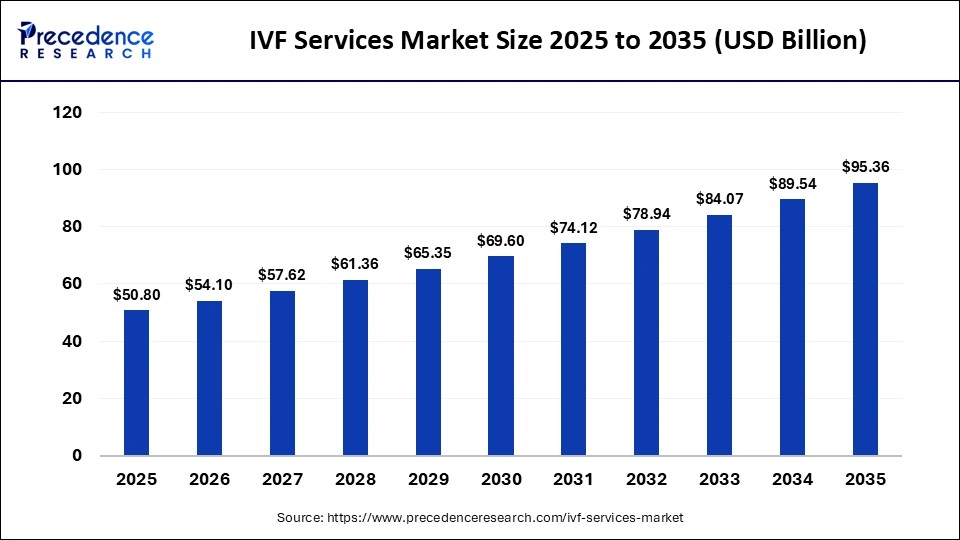
The global IVF services market is entering a transformative phase as infertility cases continue to rise worldwide and more individuals are choosing parenthood later in life. The market was valued at USD 50.80 billion in 2025 and is projected to grow from USD 54.10 billion in 2026 to approximately USD 95.36 billion by 2035, expanding at a CAGR of 6.50% during the forecast period. The growth trajectory is being supported by the increasing prevalence of fertility disorders, wider acceptance of assisted reproductive technologies, and ongoing improvements in embryo transfer, cryopreservation, and genetic screening procedures.
Read Also: Veterinary Urinalysis Market
Quick Insights
- The global IVF services market stood at USD 50.80 billion in 2025 and is forecast to reach USD 95.36 billion by 2035.
- Europe remained the leading regional market in 2025 with a 39% share due to supportive reimbursement policies and strong public fertility programs.
- Asia Pacific is projected to witness the fastest growth through 2035, supported by rising infertility rates, expanding fertility clinic networks, and lower treatment costs.
- Fertility clinics accounted for 65% of the total market share in 2025 due to their specialized expertise and dedicated reproductive care infrastructure.
- Fresh IVF cycles represented 49% of the market in 2025, while thawed IVF cycles are expected to expand rapidly due to improved cryopreservation techniques.
- IVF with ICSI continues to gain strong adoption because of its higher success rates in male infertility cases.
How Is Artificial Intelligence Influencing the IVF Services Market?
Artificial intelligence is increasingly becoming an important component of IVF treatment workflows. AI-driven systems are helping fertility specialists analyze embryo quality, improve implantation success rates, and identify the most viable embryos with greater precision. Time-lapse imaging technologies combined with AI can reduce subjectivity in embryo grading, allowing clinics to improve treatment outcomes and reduce the number of unsuccessful IVF cycles.
AI is also supporting fertility clinics through predictive analytics, patient data management, and personalized treatment recommendations. By integrating clinical history, hormonal data, and genetic insights, AI tools can help clinicians tailor stimulation protocols and improve the overall patient journey. As digital health technologies continue to mature, AI is expected to play a central role in making IVF procedures more efficient, accessible, and outcome-driven.
What Are the Major Growth Factors Driving the IVF Services Market?
Why Are Rising Infertility Rates Increasing Demand for IVF Services?
The growing burden of infertility is one of the most important factors driving the IVF services market. Lifestyle changes, stress, obesity, smoking, delayed marriages, and hormonal disorders are increasing infertility rates among both men and women. Many patients are turning to IVF services as a reliable fertility solution when natural conception becomes difficult.
How Is Delayed Parenthood Influencing Market Growth?
A rising number of individuals are postponing parenthood due to career priorities, financial planning, and lifestyle preferences. Delayed pregnancies often lead to reduced fertility and increased reproductive complications, making IVF treatments more necessary. This trend is particularly visible in urban populations across Europe, North America, and Asia Pacific.
Why Is Fertility Preservation Becoming More Important?
Fertility preservation services such as egg freezing, sperm freezing, and embryo cryopreservation are becoming increasingly popular. Younger individuals are choosing fertility preservation as a proactive reproductive strategy, particularly before cancer treatments or delayed parenthood decisions. This is creating additional long-term demand for IVF-related procedures and services.
What Opportunities Are Emerging in the IVF Services Market?
Can Expanding Fertility Clinic Networks Unlock New Revenue Streams?
The rapid expansion of fertility clinics in emerging markets is expected to create significant growth opportunities. Specialized fertility centers are being established across Asia Pacific, Latin America, and the Middle East, improving access to assisted reproductive technologies for a wider population. This expansion is reducing geographical barriers and increasing the volume of IVF procedures globally.
How Are Advanced Embryology Technologies Changing IVF Outcomes?
Technologies such as time-lapse embryo imaging, genetic testing, lab automation, and cryopreservation are enhancing the efficiency and success rates of IVF treatments. These technologies are helping clinicians improve embryo selection, reduce treatment failures, and enhance patient confidence in assisted reproductive procedures.
Segment Analysis
Cycle Type Analysis
Fresh IVF cycles dominated the market in 2025 with a 49% share due to their clinical preference for immediate embryo transfer and reduced dependence on cryopreservation infrastructure. Patients with stable hormone levels and strong ovarian reserves often prefer fresh cycles because they support quicker treatment timelines and faster recovery.
Thawed IVF cycles represented 35% of the market in 2025 and are expected to witness the fastest growth over the coming years. Improvements in embryo freezing techniques and frozen embryo transfer protocols are helping clinics optimize uterine conditions and improve success rates. These cycles are becoming particularly popular in patients with diminished ovarian reserve or genetic concerns.
Procedure Analysis
IVF with ICSI has emerged as the leading procedure segment because of its effectiveness in treating male infertility cases. The technique allows a single sperm to be injected directly into an egg, improving fertilization rates in patients with low sperm count or poor sperm motility. The increasing diagnosis of male infertility is expected to support the continued expansion of this segment.
IVF with donor eggs is also gaining traction due to growing acceptance among older women, single parents, and same-sex couples. The increasing availability of donor programs and egg banks is helping improve access to donor-assisted reproductive procedures.
End-User Analysis
Fertility clinics held the largest market share of 65% in 2025 because they provide specialized reproductive care, shorter waiting times, and advanced laboratory infrastructure. Clinics equipped with embryo monitoring systems, genetic testing capabilities, and skilled embryologists continue to attract a large patient base.
Hospitals are expected to grow at the fastest pace due to their ability to manage complex infertility cases that require multidisciplinary care, imaging, surgery, and critical care services within a single facility.
Regional Analysis
Why Does Europe Continue to Lead the IVF Services Market?
Europe dominated the global IVF services market with a 39% share in 2025. The region benefits from supportive public funding, favorable reimbursement policies, and strong clinical standards. Countries such as Spain, France, and Denmark have developed mature IVF ecosystems with high treatment volumes and advanced reproductive infrastructure. Europe also records more than 1.1 million assisted reproductive technology cycles annually, making it one of the largest fertility treatment hubs globally.
What Makes Asia Pacific the Fastest-Growing Market?
Asia Pacific is projected to expand at the fastest rate due to growing infertility rates, rising disposable incomes, and the rapid establishment of fertility clinics. Countries such as India, China, Japan, and Thailand are seeing strong demand for IVF procedures because of greater awareness, lower treatment costs, and supportive healthcare investments. India alone is estimated to perform between 2 lakh and 2.5 lakh IVF cycles annually, highlighting the region’s strong growth potential.
How Is North America Supporting Continued Growth?
North America held the second-largest market share in 2025, supported by advanced reproductive technologies, strong private fertility clinic networks, and high patient awareness. The U.S. recorded more than 100,000 IVF births in 2026, reflecting strong procedural adoption and clinical capacity.
Leading Companies in the IVF Services Market
Major companies operating in the IVF services market include:
- Vitrolife
- CooperSurgical
- Merck KGaA
- Hamilton Thorne
- Nikon Corporation
- ZEISS Group
- Genea Biomedx
- Fairtility
- Nova IVF Fertility
Case Study: India’s Emergence as a Global IVF Destination
India is rapidly emerging as a major IVF destination because of its lower treatment costs, improving healthcare infrastructure, and growing number of specialized fertility clinics. Many international patients from the UK, North America, and the Middle East are choosing India for fertility treatments because of affordable pricing and high-quality clinical care. The country is also benefiting from expanding clinic networks and rising awareness around reproductive health.
Download a sample report: https://www.precedenceresearch.com/sample/8300
For inquiries regarding discounts, bulk purchases, or customization requests, please contact us at [email protected]