
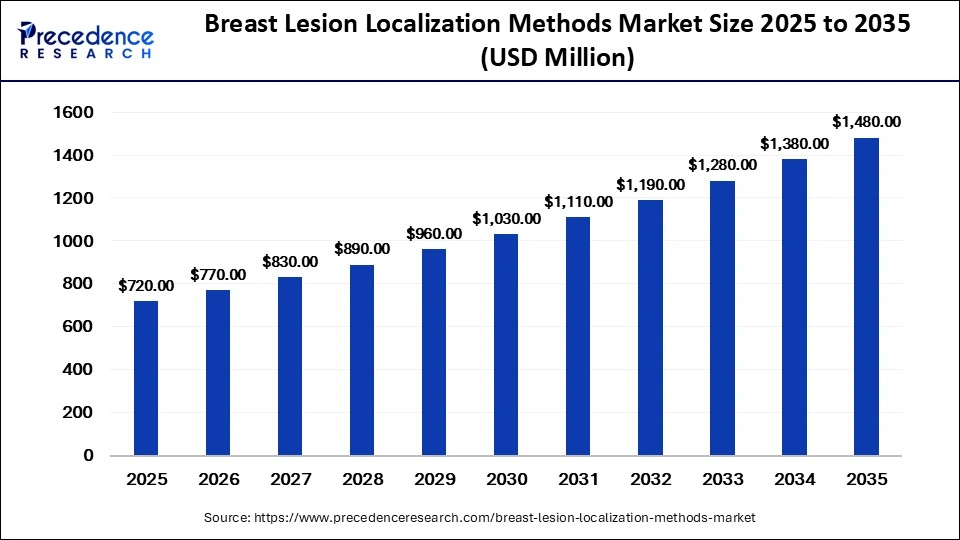
The global breast lesion localization methods market size was valued at USD 720 million in 2025 and is projected to grow from USD 770 million in 2026 to approximately USD 1.48 billion by 2035, registering a CAGR of 7.47% during the forecast period from 2026 to 2035. The market is experiencing substantial growth due to the increasing global burden of breast cancer, rising awareness regarding early-stage diagnosis, and growing demand for minimally invasive and precision-guided breast surgeries.
Breast lesion localization methods are becoming increasingly critical in modern oncology as healthcare providers focus on improving surgical accuracy, reducing re-excision rates, and enhancing patient outcomes during breast-conserving surgeries and biopsy procedures. These localization technologies assist surgeons in accurately identifying non-palpable breast lesions that cannot be physically detected during clinical examination.
The market is also benefiting from continuous advancements in imaging technologies, wireless localization systems, AI-assisted diagnostics, and magnetic seed technologies that improve workflow efficiency while enhancing patient comfort.
Read Also: Injectable Peptides Drugs Market
Quick Insights: What Is Driving the Breast Lesion Localization Methods Market?
North America dominated the global breast lesion localization methods market with a 42% share in 2025 due to advanced healthcare infrastructure, strong breast cancer screening programs, and widespread adoption of innovative localization technologies.
Asia Pacific is projected to expand at the fastest CAGR of 9% during the forecast period because of increasing healthcare investments, rising awareness regarding early cancer detection, and growing adoption of advanced imaging systems.
The wire localization segment held the largest market share of 45% in 2025 owing to its long-standing clinical reliability and widespread availability across hospitals and diagnostic centers.
Magnetic seed localization is expected to witness robust growth at a CAGR of 10.5% due to its wireless capabilities, improved workflow flexibility, and growing preference for minimally invasive procedures.
Localization wires accounted for the largest product segment with a 40% share in 2025 because of their established use in breast-conserving surgeries and biopsy procedures.
Ultrasound-guided imaging led the market with a 45% share in 2025 owing to its cost-effectiveness, accessibility, and radiation-free imaging capabilities.
Hospitals captured 60% of total market revenue in 2025 due to the availability of specialized oncology services, advanced imaging systems, and integrated surgical care.
Breast cancer surgery remained the leading application segment with a 70% market share in 2025 because of the increasing demand for precise tumor localization and breast-conserving procedures.
Why Are Breast Lesion Localization Methods Becoming Essential in Modern Breast Cancer Care?
Breast lesion localization methods are widely used in breast cancer surgeries, biopsies, and diagnostic procedures to identify and accurately target suspicious tissue abnormalities within the breast. These methods are particularly important for non-palpable lesions detected through mammography, ultrasound, or MRI screenings.
The increasing adoption of breast-conserving surgeries is significantly driving demand for advanced localization techniques capable of improving surgical precision while minimizing tissue damage.
Modern localization technologies help clinicians:
- Improve surgical accuracy
- Reduce repeat surgeries
- Enhance cosmetic outcomes
- Minimize patient discomfort
- Streamline surgical workflows
- Improve early-stage cancer treatment outcomes
The growing global emphasis on early breast cancer detection is further accelerating market demand for highly precise and minimally invasive localization solutions.
How Is Artificial Intelligence Transforming the Breast Lesion Localization Methods Market?
Artificial intelligence is rapidly revolutionizing the breast lesion localization methods market by improving imaging analysis, lesion detection accuracy, and surgical planning efficiency.
AI-powered systems integrated with mammography, ultrasound, and MRI platforms can automatically identify suspicious breast lesions with greater speed and accuracy. These technologies help radiologists detect subtle abnormalities, improve diagnostic consistency, and reduce false-negative rates.
AI algorithms are increasingly being used for:
- Automated lesion segmentation
- Real-time image analysis
- Predictive oncology analytics
- Surgical workflow optimization
- Localization marker placement guidance
- Digital pathology integration
The integration of AI into digital health platforms is also streamlining multidisciplinary collaboration among radiologists, surgeons, and oncology teams while improving patient management efficiency.
The increasing use of AI-assisted imaging systems is expected to significantly improve diagnostic precision and patient outcomes throughout the forecast period.
What Are the Major Growth Drivers Fueling the Market?
Rising Global Awareness of Breast Cancer Screening
Government-led awareness campaigns and national breast cancer screening programs are significantly increasing early detection rates globally. Earlier diagnosis of non-palpable lesions is directly boosting demand for precise localization procedures.
Growing Demand for Minimally Invasive Procedures
Healthcare providers increasingly prefer breast-conserving surgeries and minimally invasive biopsy techniques that require highly accurate lesion localization technologies.
Advancements in Wireless Localization Technologies
The shift from traditional wire-guided systems toward wireless, radiation-free localization technologies is driving innovation and improving surgical workflow efficiency.
Expanding Adoption of Precision Oncology
Precision-guided oncology procedures require advanced imaging and localization technologies to improve treatment planning and clinical outcomes.
Improvements in Imaging Technologies
Advancements in digital mammography, MRI, ultrasound imaging, and AI-assisted diagnostics are significantly enhancing lesion detection and localization accuracy.
Could Wireless Localization Technologies Replace Traditional Wire-Guided Systems?
Wireless localization technologies are rapidly emerging as one of the strongest growth opportunities within the breast lesion localization methods market. Conventional wire-guided systems often create scheduling challenges and patient discomfort because wires are typically inserted on the same day as surgery.
Modern wireless systems such as:
- Magnetic seed localization
- Radar localization
- RFID localization
- Radiofrequency-guided systems
offer several advantages including:
- Improved patient comfort
- Flexible scheduling
- Reduced procedural complexity
- Radiation-free operation
- Enhanced surgical precision
- Better workflow efficiency
Healthcare providers are increasingly adopting these next-generation technologies to improve patient experiences while streamlining oncology procedures.
Why Did Wire Localization Continue Leading the Market in 2025?
The wire localization segment maintained market leadership with a 45% share in 2025 due to its long-standing clinical acceptance, affordability, and broad availability.
Wire-guided localization has remained a trusted solution in breast cancer surgeries because:
- It is clinically proven
- It offers high procedural reliability
- It is cost-effective
- It is widely available across hospitals
- Physicians are highly familiar with the technique
Despite growing competition from wireless technologies, wire localization continues playing a major role in breast-conserving surgeries and biopsy procedures globally.
Why Is Magnetic Seed Localization Gaining Strong Momentum?
Magnetic seed localization accounted for 18% of the market in 2025 and is expected to grow at a CAGR of 10.5% through 2035 due to its scheduling flexibility and operational simplicity.
Magnetic seeds can be implanted several days before surgery, eliminating same-day wire placement procedures and improving workflow efficiency for both patients and clinicians.
The technology is gaining popularity because it:
- Improves patient convenience
- Reduces surgical delays
- Enhances scheduling flexibility
- Eliminates external wires
- Improves surgical precision
Healthcare providers increasingly view magnetic localization systems as a patient-friendly alternative to traditional methods.
What Challenges Are Restricting Market Expansion?
Limited Access to Advanced Healthcare Infrastructure
Many low- and middle-income regions continue facing infrastructure limitations that restrict adoption of advanced breast imaging and localization technologies.
High Equipment and Procedure Costs
Advanced wireless and AI-assisted localization systems often require significant investments, limiting accessibility for smaller hospitals and clinics.
Shortage of Skilled Specialists
The growing complexity of advanced breast imaging and localization procedures is increasing demand for trained radiologists and breast surgeons.
Regulatory and Operational Complexity
Certain radioisotope-based localization technologies require strict regulatory compliance and specialized handling procedures.
Segment Analysis: Which Technologies Are Driving Revenue Growth?
RFID Localization Emerging as the Fastest-Growing Technique
RFID localization is projected to grow at the fastest CAGR of 11% due to:
- Real-time lesion tracking
- Wireless operation
- High localization precision
- Radiation-free procedures
- Improved surgical workflows
Localization Seeds Witnessing Strong Adoption
Localization seeds are expected to grow rapidly due to their minimally invasive nature and increasing demand for non-wire solutions.
Ultrasound-Guided Imaging Dominates Clinical Practice
Ultrasound-guided localization accounted for 45% market share in 2025 because it:
- Avoids radiation exposure
- Is cost-effective
- Is widely accessible
- Enables real-time imaging guidance
MRI-Guided Imaging Gaining Popularity in Complex Cases
MRI-guided localization is increasingly used for difficult-to-detect lesions that are not visible through ultrasound or mammography.
Why Did Hospitals Dominate the Market?
Hospitals accounted for 60% of total market revenue in 2025 due to:
- Advanced oncology infrastructure
- Availability of specialized surgical teams
- Access to advanced imaging technologies
- Integrated patient care capabilities
Hospitals remain primary centers for breast cancer diagnosis, surgery, and post-operative care, supporting widespread adoption of advanced localization technologies.
Regional Analysis: Which Regions Are Leading the Market?
Why Is North America Dominating the Market?
North America held 42% of global market share in 2025 due to:
- Advanced healthcare systems
- Strong breast cancer awareness
- Well-established screening programs
- Early adoption of advanced localization technologies
- Favorable reimbursement policies
The United States continues leading regional growth due to increasing breast cancer screening participation and widespread adoption of AI-powered imaging platforms.
Why Is Asia Pacific Emerging as the Fastest-Growing Region?
Asia Pacific is projected to grow at the fastest CAGR of 9% because of:
- Rising breast cancer incidence
- Expanding healthcare investments
- Improving diagnostic infrastructure
- Increasing awareness regarding early diagnosis
- Growing adoption of advanced imaging systems
Countries such as China, Japan, and India are significantly increasing investments in breast cancer screening and precision oncology technologies.
Europe Maintains Strong Market Position
Europe remains the second-largest regional market with a 28% share in 2025 due to:
- National breast cancer screening programs
- Strong public healthcare systems
- Growing demand for minimally invasive procedures
- Increasing healthcare digitization
The UK continues playing a major role through its structured NHS breast cancer screening initiatives.
Competitive Landscape: Which Companies Are Shaping the Industry?
The breast lesion localization methods market is highly competitive as medical device manufacturers increasingly focus on wireless localization technologies, AI-assisted imaging, and precision oncology solutions.
Major Companies Operating in the Market
- Hologic
- BD (Becton Dickinson)
- Cook Medical
- Merit Medical Systems
- Argon Medical Devices
- SOMATEX Medical Technologies
- Endomagnetics
- Cianna Medical
- IZI Medical Products
- Theragenics Corporation
- Stryker
- GE HealthCare
- Siemens Healthineers
- Bard Medical
- Mammotome
These companies are investing heavily in:
- Wireless localization systems
- AI-powered imaging technologies
- Precision-guided surgical tools
- Magnetic seed systems
- Smart oncology workflows
What Recent Innovations Are Transforming the Market?
The market is witnessing rapid technological innovation across imaging and localization systems.
QT Imaging Expands Radiation-Free Breast Imaging
In March 2026, QT Imaging entered into a UAE-exclusive distribution agreement for its FDA-cleared Breast Acoustic CT scanner and cloud platform, providing radiation-free 3D breast imaging capabilities.
Hologic Introduces AI-Controlled Imaging Technologies
In December 2024, Hologic launched AI-powered breast imaging innovations including the Envision Mammography Platform and Genius AI Detection PRO solution to improve cancer detection accuracy and patient comfort.
Stryker Strengthens Wireless Localization Portfolio
In July 2024, Stryker acquired MOLLI Surgical Inc. to enhance its capabilities in wireless breast lesion localization technologies and improve surgical precision workflows.
Conclusion: Precision Oncology and AI Integration Are Redefining Breast Lesion Localization
The breast lesion localization methods market is entering a new era of innovation driven by rising breast cancer incidence, technological advancements in imaging systems, and increasing demand for minimally invasive oncology procedures.
Future market growth will increasingly focus on:
- AI-powered diagnostics
- Wireless localization systems
- Radiation-free imaging
- Precision-guided oncology workflows
- Real-time surgical navigation
- Patient-centric treatment approaches
As healthcare systems continue investing in advanced oncology technologies, breast lesion localization methods will play an increasingly critical role in improving early breast cancer diagnosis and surgical precision globally.
Get a Sample Copy: https://www.precedenceresearch.com/sample/8397
For inquiries regarding discounts, bulk purchases, or customization requests, please contact us at [email protected]