
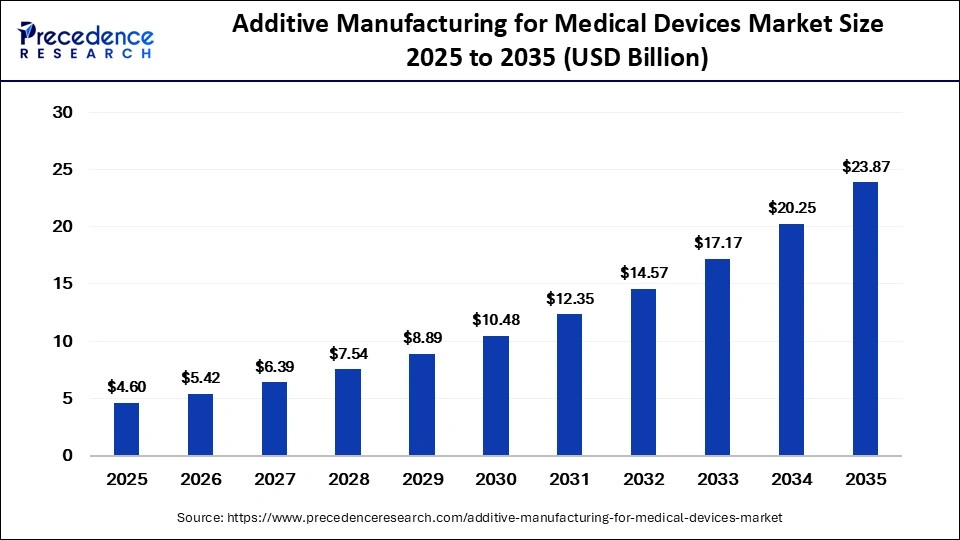
The global additive manufacturing for medical devices market is projected to hit USD 23.87 billion by 2035, driven by personalized implants, AI-powered 3D printing, bioprinting innovations, and rising healthcare digitization.
Additive Manufacturing for Medical Devices Market Overview
The global additive manufacturing for medical devices market is experiencing transformative growth as healthcare providers increasingly adopt 3D printing technologies to improve precision, customization, and patient outcomes. According to Precedence Research, the market was valued at USD 4.60 billion in 2025 and is projected to grow from USD 5.42 billion in 2026 to approximately USD 23.87 billion by 2035, expanding at a CAGR of 17.90% during the forecast period.
Additive manufacturing, commonly referred to as 3D printing, enables the production of customized medical devices such as orthopedic implants, dental implants, prosthetics, surgical guides, and tissue-engineered products. The technology allows healthcare providers to create patient-specific solutions based on digital imaging data, significantly improving surgical accuracy and recovery outcomes.
The growing focus on personalized medicine, advancements in biomaterials, and increasing integration of artificial intelligence into manufacturing processes are reshaping the future of medical device production. Healthcare institutions are increasingly investing in in-house 3D printing capabilities to accelerate production timelines and reduce dependency on traditional manufacturing methods.
Read Also: Immunochemistry Instruments and Reagents Market
What is Additive Manufacturing in Medical Devices?
Additive manufacturing is a process that creates three-dimensional objects layer by layer using digital models. In healthcare, this technology is widely used for producing customized medical devices tailored to the anatomy of individual patients.
Applications include:
- Orthopedic implants
- Dental prosthetics
- Surgical instruments
- Anatomical models
- Prosthetic limbs
- Orthotic devices
- Tissue engineering and bioprinting
Unlike traditional manufacturing, additive manufacturing offers superior design flexibility, reduced material waste, shorter production cycles, and the ability to create highly complex geometries.
Key Market Drivers
Rising Demand for Personalized Medical Devices
One of the primary drivers of the additive manufacturing for medical devices market is the increasing demand for patient-specific implants and customized treatment solutions. Traditional manufacturing methods often struggle to produce implants tailored to individual anatomical structures.
3D printing technologies allow healthcare providers to design implants and prosthetics based on CT scans and MRI imaging, ensuring better fit, enhanced comfort, and improved functionality. Customized implants also reduce surgical time and accelerate patient recovery.
The orthopedic implants segment accounted for approximately 30% of the market share in 2025, highlighting the growing adoption of personalized orthopedic solutions.
Rapid Advancements in Biocompatible Materials
Innovations in biomaterials are significantly supporting market growth. Manufacturers are increasingly using titanium, polymers, ceramics, and bioresorbable materials to develop durable and biocompatible implants.
The metals segment dominated the market with a 40% share in 2025 due to its superior strength, corrosion resistance, and regulatory acceptance. Titanium-based implants remain highly preferred for orthopedic and dental applications.
Meanwhile, the biomaterials segment is projected to expand at the fastest CAGR of 21.5% through 2035, fueled by increasing investments in tissue engineering and regenerative medicine.
Integration of Artificial Intelligence
Artificial intelligence is revolutionizing additive manufacturing processes across the healthcare industry. AI-powered systems optimize design structures, improve printing precision, and automate quality inspections.
Generative design algorithms enable manufacturers to create lightweight lattice structures that enhance osseointegration and implant durability. AI also supports predictive maintenance, defect detection, and real-time optimization of printing parameters, significantly improving manufacturing efficiency.
Growth of Point-of-Care Manufacturing
Hospitals are increasingly establishing on-site 3D printing labs to produce patient-specific devices on demand. Point-of-care manufacturing enables rapid production of customized implants, surgical guides, and prosthetics while reducing delivery timelines.
The hospitals segment held the largest market share of 45% in 2025 due to growing adoption of in-house additive manufacturing technologies.
Market Restraints
High Initial Investment Costs
Despite substantial growth opportunities, the market faces challenges associated with the high cost of advanced 3D printing systems and specialized biomaterials. Metal-based additive manufacturing systems require significant capital investment, limiting adoption among smaller healthcare facilities.
Operational expenses related to maintenance, material sourcing, and regulatory compliance also increase overall production costs.
Regulatory and Quality Compliance Challenges
Medical devices must comply with strict regulatory standards to ensure safety and effectiveness. Regulatory approval processes for 3D-printed implants and bioprinted products can be time-consuming and expensive.
Ensuring consistent product quality and reproducibility remains a key concern for manufacturers, especially for highly customized devices.
Shortage of Skilled Professionals
The implementation of additive manufacturing technologies requires trained engineers, biomedical specialists, and skilled technicians. Limited availability of qualified professionals may hinder market growth in developing regions.
Emerging Opportunities
Expansion of Tissue Engineering and Bioprinting
Bioprinting represents one of the most promising areas in the market. Researchers are increasingly developing bioinks and tissue-engineered products for regenerative medicine applications.
The tissue engineering segment is expected to grow at a CAGR of 20.5% during the forecast period, driven by rising investments in organ printing and regenerative healthcare solutions.
Increasing Adoption in Emerging Economies
Emerging economies such as India, China, and Brazil are witnessing rapid healthcare infrastructure development and increasing investments in advanced medical technologies.
Governments and private organizations are supporting initiatives aimed at strengthening domestic medical device manufacturing capabilities. The rising demand for affordable customized implants is creating strong growth opportunities across Asia Pacific.
Growing Demand for Dental Applications
Additive manufacturing is increasingly used in dental implant production, aligners, and orthodontic devices. The technology enables highly accurate and cost-effective manufacturing of customized dental solutions.
The dental implants segment accounted for 22% of the market share in 2025 due to rising adoption of digital dentistry and personalized dental care.
Technology Insights
Selective Laser Sintering (SLS) Leads the Market
Selective Laser Sintering emerged as the leading technology segment with a 25% market share in 2025. SLS technology enables the production of strong, detailed, and highly customized medical devices without requiring support structures.
The technology is widely used for orthopedic implants, surgical tools, and patient-specific prosthetics.
Direct Metal Laser Sintering (DMLS) Witnessing Rapid Growth
The DMLS segment is projected to grow at a CAGR of 20.5% through 2035 due to increasing demand for titanium and cobalt-chromium implants.
DMLS allows manufacturers to create highly complex geometries with excellent precision and biocompatibility, making it ideal for orthopedic and dental applications.
Regional Analysis
North America Dominates the Global Market
North America accounted for approximately 40% of the global market share in 2025. The region benefits from advanced healthcare infrastructure, high healthcare spending, and strong adoption of innovative medical technologies.
The United States remains the largest contributor to regional growth, supported by increasing adoption of personalized implants and strong investments in digital healthcare transformation. The U.S. market is expected to reach nearly USD 7.30 billion by 2035.
Asia Pacific Expected to Grow Fastest
Asia Pacific is anticipated to witness the fastest CAGR of 23.5% during the forecast period. Rising healthcare expenditure, growing medical tourism, and expanding healthcare infrastructure are major factors driving regional growth.
Countries such as India, China, Japan, and South Korea are increasingly adopting additive manufacturing technologies for orthopedic, dental, and prosthetic applications.
Europe Maintains Strong Position
Europe continues to hold a significant share of the market due to strong research capabilities and growing investments in advanced manufacturing technologies.
Countries including Germany, the UK, and France are actively supporting innovation in medical 3D printing and bioprinting applications.
Competitive Landscape
The additive manufacturing for medical devices market is highly competitive, with companies focusing on strategic partnerships, technological innovation, and product development.
Key Companies Operating in the Market
Major players include:
- 3D Systems
- Stratasys
- Materialise
- GE Additive
- Stryker
- Zimmer Biomet
- Medtronic
- EOS GmbH
- Renishaw
Recent Industry Developments
Recent developments demonstrate the rapid evolution of the industry:
- Companies are increasingly integrating AI-driven design optimization and real-time quality inspection systems into additive manufacturing workflows.
- Healthcare institutions are expanding point-of-care manufacturing facilities to produce patient-specific implants and surgical models internally.
- Researchers are advancing bioprinting technologies aimed at tissue regeneration and organ fabrication, creating long-term opportunities for regenerative medicine.
Future Outlook
The future of the additive manufacturing for medical devices market remains highly promising as healthcare systems continue transitioning toward personalized medicine and digital manufacturing technologies.
Advancements in biomaterials, artificial intelligence, tissue engineering, and high-precision printing systems are expected to unlock new opportunities across orthopedic, dental, cardiovascular, and regenerative medicine applications.
Growing healthcare investments, increasing prevalence of chronic diseases, and rising demand for customized treatment solutions will continue driving adoption globally. As additive manufacturing technologies become more affordable and scalable, they are expected to become a cornerstone of next-generation healthcare manufacturing.
Get a Sample Copy: https://www.precedenceresearch.com/sample/8406
For inquiries regarding discounts, bulk purchases, or customization requests, please contact us at [email protected]