
What is the Skin Health Dermatology Functional Foods Market Size in 2026?
The global skin health dermatology functional foods market size was calculated at USD 4.32 billion in 2025 and is predicted to increase from USD 4.70 billion in 2026 to approximately USD 9.98 billion by 2035, expanding at a CAGR of 8.73% from 2026 to 2035. The market is experiencing tremendous growth due to consumers’ interest in the relationship between nutrition and skin vitality. Self-enriched functional foods containing bioactive compounds are being adopted as preventive measures to improve skin health, support collagen synthesis, and alleviate internal dermatological issues.
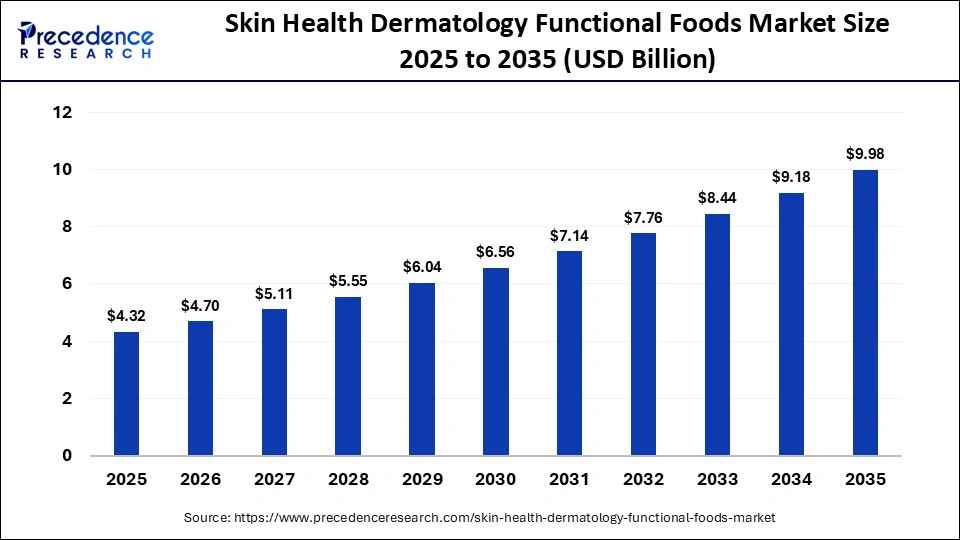
Market Highlights
- North America emerged as the leading regional market for skin health dermatology functional foods in 2025, driven by strong consumer awareness and rising demand for wellness-based skincare solutions.
- Asia-Pacific is projected to witness the fastest market growth during the forecast period due to increasing health consciousness, urbanization, and expanding beauty nutrition trends.
- By product type, the dietary supplements segment accounted for the largest market share in 2025 owing to growing adoption of collagen, probiotic, and antioxidant-based ingestible skincare products.
- The fortified foods segment is anticipated to register the fastest CAGR between 2026 and 2035 as consumers increasingly prefer functional everyday nutrition products supporting skin wellness.
- Based on ingredient type, botanical extracts dominated the global market in 2025 because of rising consumer preference for natural, plant-based, and clean-label skincare nutrition ingredients.
- The vitamins and minerals segment is expected to grow at the highest rate during the forecast period, supported by increasing awareness regarding micronutrient deficiencies and skin health optimization.
- By distribution channel, the direct-to-consumer (DTC) segment held the dominant market position in 2025 as brands increasingly leveraged digital platforms and personalized wellness strategies.
- The e-commerce segment is projected to expand at the fastest CAGR during the studied period due to growing online health supplement purchases and digital retail penetration.
- By application, the anti-aging segment captured the largest market share in 2025, fueled by increasing demand for collagen-supporting and skin rejuvenation products.
- The UV protection segment is expected to witness the fastest growth over the forecast period as consumers increasingly seek ingestible solutions for skin defense against environmental and sun-related damage
Skin Health Dermatology Functional Foods Market: The Rise of Beauty-from-Within Nutrition
The global skin health dermatology functional foods market is rapidly emerging at the intersection of nutrition, skincare, and wellness innovation. Consumers are increasingly shifting from reactive skincare treatments toward preventive and nutrition-based approaches that support skin hydration, elasticity, collagen production, and overall skin wellness from within.
Functional foods enriched with collagen peptides, probiotics, antioxidants, vitamins, ceramides, and botanical extracts are becoming essential components of daily wellness routines. The market is witnessing strong momentum as health-conscious consumers, particularly millennials and aging populations, actively seek scientifically backed “beauty-from-within” solutions that promote healthier and younger-looking skin.
Growing awareness regarding holistic skincare, clean-label nutrition, and personalized wellness is further accelerating demand for ingestible dermatology products worldwide.
How AI is Transforming Skin Health, Dermatology, and Functional Foods
Artificial intelligence (AI) is revolutionizing the skin health and functional foods industry by enabling highly personalized nutrition and skincare solutions. AI-powered platforms can analyze consumer biomarkers, genetic profiles, microbiome data, lifestyle patterns, and skin conditions to recommend customized nutritional formulations targeting concerns such as aging, pigmentation, inflammation, acne, and collagen degradation.
Machine learning technologies are also accelerating the discovery of new bioactive compounds with dermatological benefits. Companies are increasingly using AI-driven analytics to identify ingredient synergies, predict consumer preferences, and optimize product formulations for enhanced skin performance.
In addition, AI-enabled diagnostic tools and skin analysis applications are helping brands develop precision-based functional foods tailored to individual skin health needs, creating a new generation of personalized ingestible beauty solutions.
Market Outlook
The skin health dermatology functional foods market is expected to witness strong growth over the coming years, supported by rising consumer focus on preventive healthcare, personalized nutrition, clean-label ingredients, and wellness-driven beauty solutions.
As AI, biotechnology, and nutritional science continue advancing, the industry is likely to experience significant innovation in precision nutrition, microbiome-based skincare, and scientifically targeted functional food formulations.
Companies investing in AI-powered personalization, clinically backed ingredients, and sustainable wellness products are expected to gain a strong competitive advantage in the rapidly evolving ingestible dermatology market.
Market Scope
| Report Coverage | Details |
|---|---|
| Market Size in 2025 | USD 4.32 Billion |
| Market Size in 2026 | USD 4.70 Billion |
| Expected Market Size by 2035 | USD 9.98 Billion |
| Growth Rate (2026–2035) | CAGR of 8.73% |
| Leading Region | North America |
| Fastest Growing Region | Asia Pacific |
| Base Year | 2025 |
| Forecast Timeline | 2026 to 2035 |
| Segments Analyzed | Product Type, Ingredient Type, Distribution Channel, Application, and Regional Markets |
| Geographic Coverage | North America, Europe, Asia Pacific, Latin America, and Middle East & Africa |
Regional Insights
North America continues to lead the skin health dermatology functional foods market due to rising consumer awareness regarding preventive skincare and wellness-focused nutrition. The region is witnessing strong demand for collagen supplements, probiotic-based skincare nutrition, and anti-aging functional products. Increasing adoption of personalized nutrition, advanced dermatological research, and premium nutricosmetics is further supporting market expansion. The presence of established wellness brands, strong retail infrastructure, and growing interest in clean-label products are also contributing to regional growth.
Asia Pacific is expected to witness the fastest growth during the forecast period, driven by rapidly evolving beauty and wellness trends across countries such as China, Japan, South Korea, and India. Consumers in the region are increasingly adopting ingestible beauty products influenced by growing skincare awareness and rising disposable incomes. The popularity of K-beauty and J-beauty trends, combined with expanding e-commerce penetration and urbanization, is significantly boosting demand for functional foods focused on skin hydration, brightening, and anti-aging benefits.
Europe represents a significant market for skin health dermatology functional foods due to increasing consumer preference for natural, organic, and scientifically validated wellness products. The region has seen growing interest in botanical extracts, probiotic supplements, and sustainable skincare nutrition solutions. Strong regulatory standards, rising awareness regarding healthy aging, and increasing adoption of holistic wellness approaches are supporting market growth across several European countries.
The Latin American market is gradually expanding as consumers become more conscious about skin wellness, beauty nutrition, and preventive healthcare. Increasing urbanization, social media influence, and growing availability of affordable dietary supplements are contributing to market development. Demand for collagen-based beverages, vitamin-enriched supplements, and functional beauty products is particularly increasing among younger consumers and wellness-focused populations.
The Middle East & Africa region is witnessing growing interest in functional foods that support skin health and overall wellness. Rising beauty consciousness, increasing demand for premium wellness products, and expanding healthcare awareness are supporting market growth. Consumers are increasingly seeking products that address skin hydration, UV protection, and healthy aging, especially in urban markets with evolving lifestyle patterns and higher disposable income levels.
Skin Health Dermatology Functional Foods Market Value Chain Analysis
- R&D
The research and development is the initial phase of the functional food supply chain, whereby the discovery and validation of bioactive compounds that enhance the health of the skin is of concern.
Key players: Nestle Health Science, BASF SE, Lonza Group, DSM-Firmenich, and Amway
- Clinical Trials
The safety and efficacy of the functional food ingredients in dermatology-based products can only be established through clinical trials.
Key players: Unilever, Nestle, Herbalife Nutrition, Amway, and Givaudan
- Formulation and Final Dosage Preparation
After the validation of functional ingredients, manufacturers concentrate on formulating products that are optimized in terms of stability, taste, absorption, and convenience to the consumer.
Key players: Kerry Group, ADM (Archer Daniels Midland), Ingredion, Tate & Lyle and BASF
- Packaging and Sterilization
The production of functional food products is done in large-scale manufacturing and quality control. At this phase, a raw material is refined, mixed, and transformed into a final consumer.
Key players: Lonza, Catalent, Glanbia Nutritionals, ADM and Kerry Group
- Distribution to Hospitals, Pharmacies
The distribution networks are crucial in the product distribution of dermatology-oriented functional foods to the healthcare providers, pharmacies, and consumers.
Key players: McKesson Corporation, Cardinal Health, Walgreens Boots Alliance, CVS Health, and AmerisourceBergen
- Patient Support and Services
The importance of the functional dermatology market is shifting towards patient support programs and educational programs.
Key players: Nestle Health Science, Amway, Herbalife Nutrition, Unilever, and Haleon
Also Read Our Latest Arcticle : Alzheimers Disease Diagnostics Market
Recent Developments
- In January 2026, innovative food products developed by ICAR-CIFT were launched in Kochi, showcasing organic snacks, gluten-free options, and fortified foods. The expo emphasized sustainability and health awareness, with local entrepreneurs highlighting diet-specific offerings. Government support for the health food market reflects growing consumer demand, promoting a shift toward healthier lifestyles and nutritional innovation.
- In December 2025, a study published in the Journal of Investigative Dermatology found that diet can boost vitamin C content and influence skin structure, while also revealing clear limits to its effects on collagen formation and UV protection. The study evaluated how skin compartments responded to dietary ascorbate and whether these changes translate to measurable improvements in skin function.
Segments Covered in the Report
By Product Type
- Dietary Supplements
- Fortified Beverages
- Fortified Foods
By Ingredient Type
- Botanical Extracts
- Aloe Vera
- Green Tea Extract
- Collagen
- Probiotics
- Vitamins & Minerals
- Vitamin C
- Vitamin E
- Zinc
By Distribution Channel
- E-commerce
- Direct To Consumer
- Marketplace
- Social Commerce
- Pharmacies & Drugstores
- Specialty Retail
- Beauty Clinics & Dermatology Centers
- Spas & Salons
- Supermarkets & Hypermarkets
By Application
- Acne Management
- Anti-Aging
- Skin Brightening
- Skin Moisturizing
- UV Protection
By Region
- North America
- Latin America
- Europe
- Asia-pacific
- Middle and East Africa
Get Sample Link : https://www.precedenceresearch.com/sample/8160