
What is the Telemedicine Market Size?
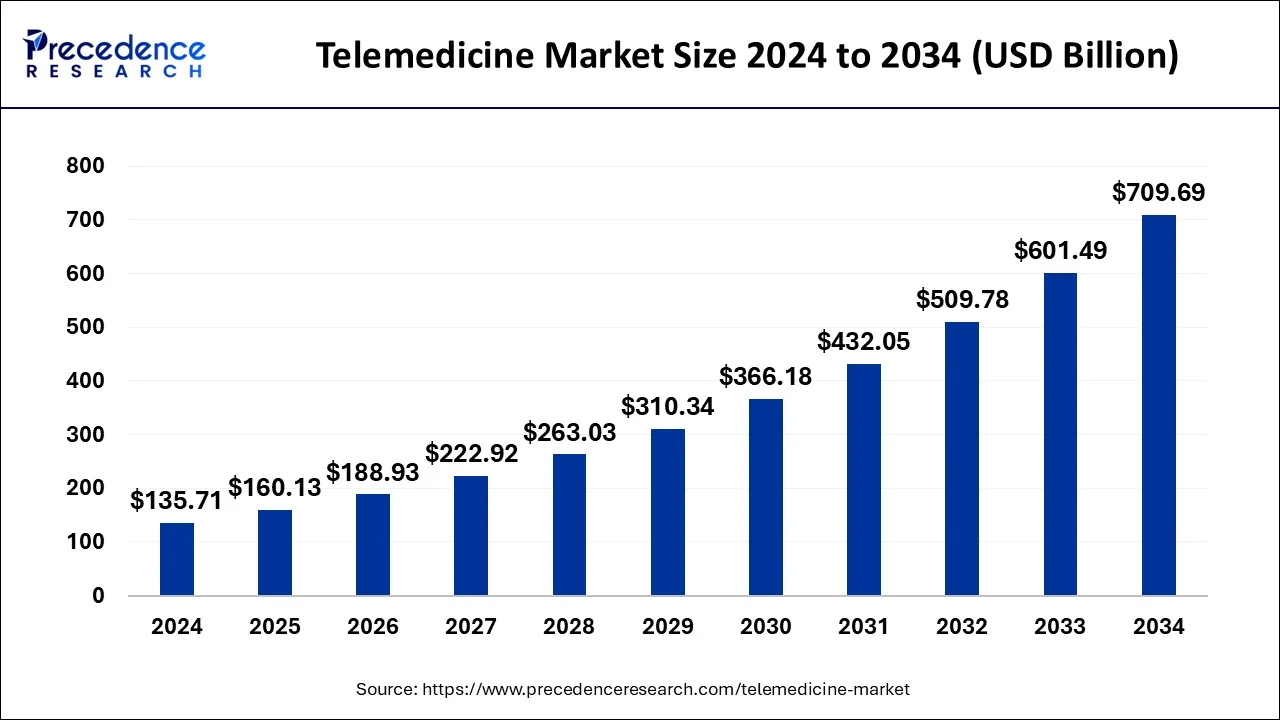
The global telemedicine market size is calculated at USD 160.13 billion in 2025 and is predicted to increase from USD 188.93 billion in 2026 to approximately USD 806.89 billion by 2035, expanding at a CAGR of 17.55% from 2026 to 2035. The telemedicine market is driven by the rising healthcare digitalization, along with the shift towards more flexible, ensuring wider worldwide access to telehealth services.
Market Highlights
- By region, North America accounted 34% revenue share in 2025.
- By type, The tele-hospital segment accounted largest market share in 2025.
- By component, The product segment accounted significant market share in 2025.
- By application, The teleradiology segment accounted largest revenue share in 2025.
- By end user, The patients segment held a dominant presence in the telemedicine market in 2025.
Telemedicine Market Overview
The global telemedicine market is experiencing significant growth as healthcare providers increasingly adopt digital technologies to deliver remote clinical services. Telemedicine uses electronic communication and telecommunication systems to connect healthcare professionals with patients regardless of geographic location, improving access to healthcare services, especially in remote and underserved regions. The technology enables patients to receive medical consultations, treatment guidance, prescription management, lifestyle recommendations, and follow-up care without physically visiting hospitals or clinics.
Telemedicine services include real-time video consultations, remote patient monitoring, and store-and-forward solutions that allow healthcare providers to review medical data such as CT scans, MRIs, X-rays, and laboratory reports remotely. Remote monitoring technologies are also increasingly being used to track vital health parameters including blood pressure, oxygen saturation, heart rate, and glucose levels through connected wearable devices and sensors. These capabilities are helping improve patient convenience, reduce healthcare costs, and enhance access to quality medical care from home environments.
Impact of Artificial Intelligence on the Telemedicine Market
Artificial intelligence is playing a transformative role in the telemedicine industry by improving healthcare accessibility, efficiency, and patient outcomes. AI and machine learning technologies are helping healthcare providers analyze large volumes of medical data, support personalized treatment planning, and predict disease patterns more accurately. AI-powered systems can automate routine patient interactions, reduce the workload on healthcare professionals, and provide faster responses to common healthcare inquiries.
Natural language processing (NLP) and conversational AI technologies are increasingly being integrated into telemedicine platforms to support virtual assistants, symptom assessment, treatment recommendations, and patient engagement services. AI algorithms are also helping match patients with healthcare providers based on clinical expertise, geographic availability, and medical urgency.
In addition, AI-enabled remote monitoring systems are enhancing chronic disease management by continuously analyzing patient health data collected through wearable devices and connected sensors. These technologies allow healthcare providers to detect health risks early, improve preventive care, and monitor patient recovery remotely. As a result, AI is making telemedicine more scalable, affordable, and efficient across global healthcare systems.
Telemedicine Market Growth Factors
- Rising Prevalence of Chronic Diseases: The increasing incidence of chronic conditions such as diabetes, cardiovascular diseases, respiratory disorders, and hypertension is driving demand for telemedicine solutions. Remote healthcare services enable continuous monitoring and efficient long-term disease management.
- Growing Geriatric Population: The rapidly aging global population is increasing demand for home-based healthcare services. Telemedicine provides elderly patients with convenient access to healthcare professionals while reducing the need for frequent hospital visits.
- Technological Advancements: Advancements in artificial intelligence, cloud computing, wearable devices, remote monitoring systems, and digital communication technologies are significantly improving telemedicine capabilities and service quality.
- Expanding Internet and Smartphone Penetration: The growing adoption of broadband internet services and smartphones worldwide is making telemedicine platforms more accessible to a larger population. Improved connectivity is supporting affordable and seamless audio and video healthcare consultations.
- Increasing Government Investments: Governments across multiple countries are investing heavily in digital healthcare infrastructure, telecommunications networks, and virtual healthcare programs to improve healthcare accessibility and strengthen healthcare systems.
- Rising Demand for Personalized Healthcare: Telemedicine platforms increasingly support precision medicine and personalized treatment approaches by enabling healthcare providers to analyze patient-specific health data and deliver customized care solutions remotely.
Market Scope
| Report Highlights | Details |
| Market Size in 2025 | USD 160.13 Billion |
| Market Size in 2026 | USD 188.93 Billion |
| Market Size by 2035 | USD 806.89 Billion |
| Growth Rate From 2026 to 2035 | CAGR of 17.55% |
| Largest Market | North America |
| Base Year | 2025 |
| Forecast Period | 2026 to 2035 |
| Segments Covered | Type, Component, Application, Technology, Delivery Mode, and region End User, and Region |
| Regions Covered | North America, Europe, Asia-Pacific, Latin America and Middle East & Africa |
Opportunity
Corporate emphasizing on healthcare solutions for employees
With the prevalence of multiple chronic diseases across the globe along with sedentary lifestyles, corporate companies, especially in developed countries have started offering multiple healthcare solutions, services and policies for their employees. This element brings an opportunity for the telemedicine market to grow. Corporate telemedicine solutions introduce telehealth services to a large and captive audience, such as employees of the company. Large corporations with a widespread workforce in different countries or regions often choose such healthcare solutions for employees. As companies seek such services, the collaboration, strategic deals or partnerships between corporates and telemedicine providers are expected to grow. This opens a set of opportunities for the telemedicine market to grow.
Market Challenge
Slower adoption of the technology by underdeveloped areas
Underdeveloped areas often lack the necessary infrastructure, such as reliable internet connectivity and even electricity, which is crucially required to operate telemedicine systems. Without a stable connection of internet, it becomes challenging to conduct video consultation or transfer medical data efficiently, hampering the seamless delivery of telemedicine services. In underdeveloped areas, the penetration of smartphones, tablets or other devices might be low, this also slows down the adoption of telemedicine services. Thus, causes a challenge for the market’s expansion.
Regional Insights
North America remains one of the leading regions in the global telemedicine market due to advanced healthcare infrastructure, high internet penetration, and widespread adoption of digital healthcare technologies. The United States and Canada are witnessing strong demand for virtual healthcare services driven by the increasing prevalence of chronic diseases, rising healthcare costs, and growing consumer preference for remote consultations. The region is also experiencing rapid adoption of AI-powered telehealth platforms, remote patient monitoring systems, and wearable healthcare devices. Government support for digital healthcare initiatives and reimbursement policies for telehealth services are further contributing to market growth.
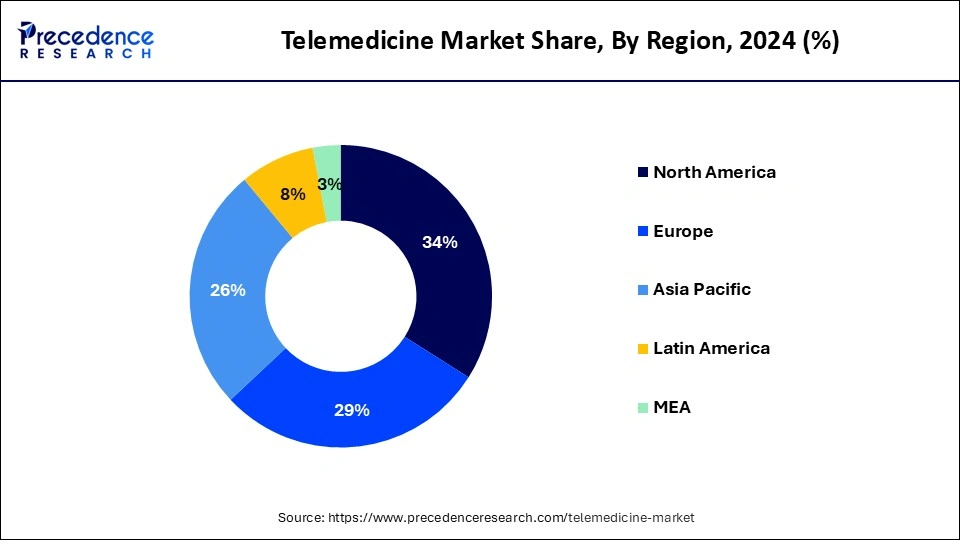
Europe is experiencing substantial growth in the telemedicine market as healthcare systems increasingly focus on improving patient accessibility and reducing pressure on hospitals. Countries such as Germany, the United Kingdom, France, Italy, and the Nordic nations are actively investing in digital health infrastructure, electronic health records, and remote care solutions. The aging population and rising incidence of chronic disorders are driving demand for home-based healthcare services across the region. Additionally, strong regulatory support for digital healthcare transformation and increasing adoption of AI-enabled healthcare technologies are accelerating telemedicine expansion throughout Europe.
Asia Pacific is emerging as one of the fastest-growing regions in the telemedicine market due to rapid digitalization, expanding smartphone usage, and improving internet connectivity. Countries including China, India, Japan, South Korea, and Australia are witnessing rising demand for virtual healthcare services, especially in rural and underserved regions where access to healthcare facilities remains limited. Government initiatives promoting digital healthcare, increasing healthcare investments, and growing adoption of AI-based telemedicine platforms are supporting market growth. The region is also benefiting from rising awareness regarding remote healthcare services and the expansion of wearable health monitoring technologies.
Latin America is experiencing increasing adoption of telemedicine services as healthcare providers focus on improving healthcare accessibility and reducing regional healthcare disparities. Countries such as Brazil, Mexico, Argentina, and Chile are increasingly implementing digital healthcare platforms for virtual consultations, remote diagnostics, and chronic disease management. Expanding mobile internet penetration, rising investments in healthcare IT infrastructure, and growing public awareness regarding telehealth services are contributing to regional market growth. The demand for affordable and convenient healthcare solutions is also accelerating telemedicine adoption across Latin America.
The Middle East & Africa region is witnessing steady growth in the telemedicine market due to ongoing healthcare modernization initiatives and increasing investments in digital health technologies. Countries such as the UAE, Saudi Arabia, South Africa, and Israel are actively promoting telehealth adoption to improve healthcare accessibility, particularly in remote and rural communities. Government-backed smart healthcare programs, rising smartphone penetration, and growing deployment of AI-powered healthcare systems are supporting market expansion. In addition, the increasing focus on remote patient monitoring, virtual consultations, and digital healthcare infrastructure is expected to further strengthen telemedicine adoption across the region.
Telemedicine Market key Players
- Koninklijke Philips N.V.
- Medtronic
- GE Healthcare
- Cerner Corporation
- Siemens Healthineers
- American Well
- AMC Health
- MDLive
Latest Announcement by Industry Leaders
- Andy Flanagan, CEO of Iris Telehealth, commented that telehealth has already proven its value in increasing access to care. However, pairing it with AI holds immense potential to provide more efficient, effective, and personalized mental health services. He added that companies should leverage such technologies to enhance human care, improving patient outcomes and experiences.
Recent Developments
- In May 2025, DLH Holdings Corp, well-known for system engineering and integration, digital transformation and cybersecurity, made an announcement that it will receive a five-year task value of up to USD 37.7 million for delivering scientific research and development, AI/ML, modeling and simulation robotic process automation, cloud-based big data analytics solution and others for TATRC- telemedicine and davanced technology research center.
- In December 2024, DocGo, Inc. announced an extended partnership with SHL Telemedicine to integrate the SmartHeart portable 12-lead ECG device across DocGo mobile health care units. The device will help reduce barriers to cardiovascular care, enabling early intervention and preventing costly emergency room visits.
- In June 2024, Apollo Telehealth and the Government of Manipur launched a telemedicine-driven primary health center in Borobeka, Manipur. The health center is inaugurated to improve healthcare access for communities affected by conflicts.
Segments Covered in the Report
By Type
- Tele-hospital
- Tele-Home
- mHealth
By Component
- Product
- Hardware
- Software
- Others
- Services
- Tele-consulting
- Tele-monitoring
- Tele-education
By Application
- Telepathology
- Teleradiology
- Teledermatology
- Telepsychiatry
- Telecardiology
- Others
By Technology
- Store & Forward
- Real-Time
- Others
By Delivery Mode
- Web/Mobile
- Telephonic
- Visualized
- Call Centers
By End-users
- Providers
- Patients
- Payers
- Others
By Region
- North America
- Latin America
- Europe
- Asia-pacific
- Middle and East Africa
Get Free Sample Link: https://www.precedenceresearch.com/sample/1366
Also Read Our Latest Article : Oculoplastic Surgery Market