
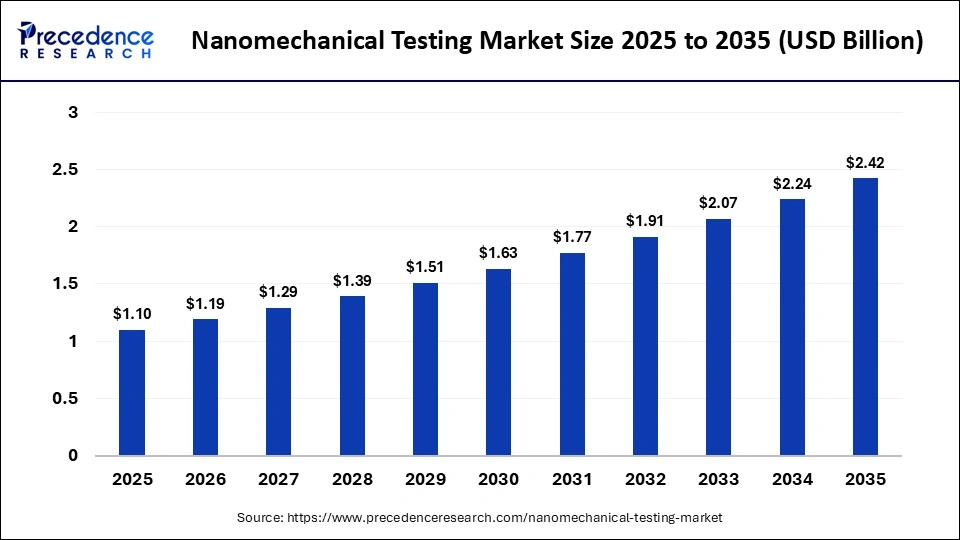
The global nanomechanical testing market is witnessing strong growth as industries increasingly demand precise material characterization at the nanoscale. The market size is projected to grow from USD 1.19 billion in 2026 to approximately USD 2.42 billion by 2035, expanding at a CAGR of 8.20% during the forecast period. The market is benefiting from the rapid miniaturization of electronic devices, increasing use of advanced materials, and growing need for accurate testing of coatings, biomaterials, semiconductors, and nanocomposites.
Nanomechanical testing is becoming essential for measuring mechanical properties such as hardness, elasticity, adhesion, creep behavior, and fracture resistance at extremely small scales. As manufacturers focus on improving durability, reliability, and product performance, nanoscale testing is becoming a critical part of quality assurance and product development strategies across multiple industries.
Read Also: Stem Cell Umbilical Cord Blood Market
Quick Insights
- The global nanomechanical testing market is expected to reach USD 1.19 billion in 2026 and grow to USD 2.42 billion by 2035.
- North America dominated the market in 2025 with a 35% revenue share.
- Asia Pacific is projected to grow at the fastest CAGR of 9.2% during the forecast period.
- Nanoindentation systems accounted for 40% of the total market share in 2025.
- Indentation testing dominated the technology segment with a 50% market share in 2025.
- Material science remained the leading end-use segment, accounting for 40% of the total market in 2025.
- Major market participants include Anton Paar GmbH, Bruker Corporation, Keysight Technologies Inc., Oxford Instruments PLC, and Shimadzu Corporation.
How is AI Transforming the Nanomechanical Testing Market?
Artificial intelligence is playing a growing role in nanomechanical testing by enabling predictive modeling, adaptive testing systems, and real-time interpretation of nanoscale material behavior. AI-driven software helps researchers predict how materials will perform under various stress, temperature, and environmental conditions, reducing the need for repeated physical testing.
AI-assisted automation is also improving testing accuracy and consistency. Advanced systems can dynamically adjust testing parameters based on live feedback, reducing human error and improving efficiency in industrial production and research environments. This is particularly valuable in sectors such as semiconductors, advanced coatings, and biomedical engineering, where even minor variations can significantly impact product performance.
What are the Major Growth Factors Supporting the Market?
One of the biggest drivers of the nanomechanical testing market is the growing trend toward miniaturization. Industries such as semiconductors, consumer electronics, healthcare, and biomedical engineering increasingly rely on ultra-small components that require highly accurate performance validation. Traditional testing methods are often insufficient for these applications, creating strong demand for nanoscale testing solutions.
The rapid adoption of advanced materials is another major growth factor. Aerospace, automotive, and industrial manufacturing companies are using lightweight composites, nanomaterials, thin films, and advanced coatings that require precise mechanical evaluation. Nanomechanical testing enables companies to measure hardness, wear resistance, elasticity, and surface adhesion, ensuring products meet durability and reliability requirements.
Why are Nanoindentation Systems Leading the Market?
Nanoindentation systems remain the largest product category because they provide highly accurate measurement of mechanical properties such as hardness, elastic modulus, and creep behavior at the nanoscale. These systems are widely used in semiconductor manufacturing, advanced materials research, and thin film characterization, where precision is critical.
Their growing popularity is also linked to advances in automation, higher resolution, and improved software integration. Modern nanoindentation platforms can deliver more reliable results, support faster testing cycles, and integrate with microscopy and imaging systems, making them indispensable across research laboratories and industrial production settings.
What Opportunities are Emerging in Healthcare and Biotechnology?
Healthcare and biotechnology represent one of the most promising future opportunities in the nanomechanical testing market. Researchers are increasingly using these testing techniques to study biomaterials, tissues, implants, prosthetics, stents, and tissue engineering scaffolds. Nanomechanical testing allows scientists to evaluate how these materials behave under physiological conditions and compare them to natural human tissues.
As chronic disease rates rise and global populations age, the need for advanced implants, medical devices, and personalized treatment solutions is increasing. Nanomechanical testing is expected to play a central role in validating the safety, strength, and long-term reliability of these healthcare technologies.
Regional Analysis
Why Does North America Continue to Lead?
North America dominated the nanomechanical testing market in 2025 with a 35% share due to its strong industrial base, advanced research ecosystem, and early adoption of cutting-edge material characterization technologies. The region benefits from extensive R&D investments, strong collaboration between universities and industries, and a large concentration of semiconductor, aerospace, and advanced manufacturing companies.
The United States remains the largest contributor within North America because of its leadership in semiconductor manufacturing, aerospace innovation, and nanoscience research. Strong government funding and industrial modernization initiatives continue to support market expansion.
Why is Asia Pacific Emerging as the Fastest-Growing Region?
Asia Pacific is projected to witness the fastest growth due to rapid industrialization, rising investments in semiconductor production, and increasing adoption of advanced testing technologies. Countries such as China, Japan, South Korea, and India are heavily investing in electronics, automotive manufacturing, and precision engineering, all of which require nanoscale material validation.
Japan is particularly notable for its strong manufacturing base and focus on robotics, advanced materials, and miniaturized electronic devices. The country’s leadership in precision engineering continues to drive demand for sophisticated nanomechanical testing systems.
Competitive Landscape and Recent Developments
The nanomechanical testing market is highly competitive, with companies focusing on expanding product capabilities, integrating AI-driven analytics, and improving automation.
Key companies operating in the market include:
- Anton Paar GmbH
- Bruker Corporation
- Keysight Technologies Inc.
- Oxford Instruments PLC
- KLA Corporation
- Shimadzu Corporation
- ZwickRoell GmbH & Co. KG
- MTS Systems Corporation
- Instron
- Nanomechanics Inc.
What Challenges Could Slow Market Growth?
Despite strong demand, the market faces challenges related to the high cost and complexity of testing equipment. Advanced nanomechanical testing systems require major upfront investments, making them difficult for small laboratories and smaller manufacturers to adopt. Maintenance costs, calibration requirements, and the need for highly skilled operators further limit broader adoption.
Industry discussions also point to challenges such as data complexity, lack of standardization in testing methods, and limited availability of trained personnel capable of operating sophisticated nanoscale testing platforms. These factors may slow adoption, particularly in developing markets.
Case Study: Semiconductor Miniaturization Driving Demand
The continued miniaturization of semiconductor components is one of the clearest examples of why nanomechanical testing is becoming essential. As chips become smaller and more powerful, manufacturers must test thin films, coatings, and microstructures with greater precision. Nanomechanical testing systems help companies validate material durability, improve performance, and reduce the risk of failure in advanced semiconductor devices
Get Sample Report: https://www.precedenceresearch.com/sample/8305
For inquiries regarding discounts, bulk purchases, or customization requests, please contact us at sales@precedenceresearch.com