
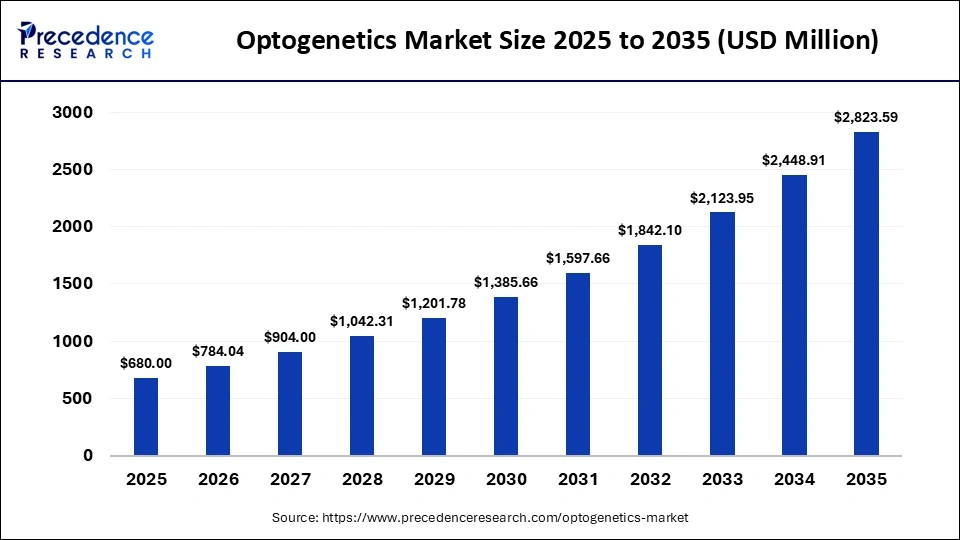
The global optogenetics market is experiencing strong momentum, with its size projected to reach USD 784.04 million in 2026, up from USD 680 million in 2025. Over the long term, the market is forecast to grow significantly, reaching approximately USD 2,823.59 million by 2035, expanding at a robust CAGR of 15.30%. This rapid growth reflects increasing investments in neuroscience, rising demand for targeted neurological therapies, and technological advancements in light-based cellular control.
Read Also: Affinity Chromatography Market
What is Optogenetics?
Optogenetics is a cutting-edge biotechnology that combines genetic engineering and optics (light technology) to precisely control specific cells—especially neurons—using light-sensitive proteins. This technique allows researchers to:
- Activate or silence neurons with high precision
- Study brain circuits and behavior
- Develop targeted treatments for neurological disorders
Its ability to manipulate cells in real-time makes it one of the most powerful tools in modern neuroscience.
Key Growth Drivers
1. Rising Neuroscience Research Funding
Governments and private institutions are heavily investing in brain research initiatives to address conditions like Parkinson’s disease, epilepsy, and depression. This funding directly fuels demand for optogenetics tools and technologies.
2. Increasing Demand for Targeted Therapies
Optogenetics enables highly precise, non-invasive therapies, making it ideal for treating complex neurological disorders where traditional drugs fall short.
3. Integration with Artificial Intelligence (AI)
AI is transforming the market by:
- Enhancing neural data analysis
- Automating experimental design
- Optimizing light stimulation parameters
This combination improves accuracy, efficiency, and reproducibility in experiments.
Deep Concept Understanding of Optogenetics
Optogenetics enables scientists to control cellular activity using light-sensitive proteins (opsins) inserted into specific cells via genetic engineering. Once these proteins are expressed, targeted light stimulation can:
- Activate or inhibit neurons instantly
- Map neural circuits with extreme precision
- Study cause-effect relationships in brain function
This technique provides superior spatial and temporal precision compared to traditional electrical or pharmacological methods.
Market Growth Dynamics
1. Rising Burden of Neurological Disorders
- Over 1 billion people globally suffer from neurological conditions, creating strong demand for advanced research tools.
- Diseases such as Parkinson’s, epilepsy, Alzheimer’s, and depression are key focus areas.
- Optogenetics offers cell-specific targeting, making it ideal for understanding and treating these disorders.
2. Rapid Advancements in Neurotechnology
- Development of high-sensitivity optical sensors and red-shifted opsins enables deeper brain penetration.
- Integration with closed-loop neuromodulation systems is accelerating real-time therapeutic applications.
3. Expansion of Biopharma & Precision Medicine
- Increasing demand for personalized medicine is driving adoption.
- Optogenetics is used in:
- Drug discovery
- Disease modeling
- Functional genomics
4. Strong Research Funding Ecosystem
- Governments and institutions are investing heavily in brain research programs.
- Academic institutions account for over 60% of market usage, highlighting early-stage innovation dominance.
Role of Artificial Intelligence (AI)
AI is transforming optogenetics into a data-driven, automated ecosystem:
- Neural Data Processing: AI analyzes complex brain signals from experiments
- Predictive Modeling: Identifies disease pathways and therapeutic targets
- Automation: Optimizes light stimulation parameters in real time
- Improved Reproducibility: Reduces experimental variability
This integration significantly enhances efficiency, accuracy, and scalability of research workflows.
Emerging Technology Trends
• Wireless & Miniaturized Systems
- Implantable, wireless devices enable real-time experiments in freely moving subjects
- Reduce invasiveness and improve behavioral studies
• Retinal & Vision Restoration Therapies
- Optogenetics is being used to restore vision in diseases like:
- Retinitis pigmentosa
- Age-related macular degeneration
• Integration with Gene Therapy
- Combines gene editing + optical control for targeted treatment
- Enables correction of disease at the cellular level
• Shift Toward Translational Medicine
- Moving from lab research to clinical applications
- Increasing clinical trials for neurological and ophthalmic disorders
Detailed Segment Analysis
1. Product Type Insights
- Light Equipment (48%): Core component for neuron stimulation
- Actuators (30%): Proteins controlling cellular activity
- Sensors (Fastest Growing): Enable real-time monitoring of neural signals
👉 Trend: Sensors + AI integration = next-gen brain mapping systems
2. Application Insights
- Neuroscience (52%): Dominant due to brain research
- Ophthalmology (Fastest Growing): Vision restoration therapies
- Cardiology: Emerging use in heart rhythm studies
👉 Future shift: From research → clinical therapy applications
3. Technique Insights
- In-vivo (62%): Real-time studies in living organisms
- In-vitro (Growing Fast): Controlled lab-based experiments
👉 Growth driver: Increasing need for scalable and reproducible experiments
4. End-User Insights
- Academic & Research Institutes (64%) dominate
- Pharma & Biotech Companies growing fastest due to:
- Drug discovery
- Clinical trials
- Therapy development
Regional Market Deep Dive
North America (Market Leader – 40%)
- Strong presence of:
- Research universities
- Biotech companies
- High funding and early technology adoption
Asia-Pacific (Fastest Growing)
- Rapid expansion of:
- Biotech startups
- Research infrastructure
- Government initiatives boosting innovation
Europe (Second Largest)
- Strong regulatory framework
- High focus on precision medicine & neuroscience research
Competitive Landscape & Innovation Focus
Leading companies shaping the market include:
- Bruker Corporation
- Danaher Corporation
- Thermo Fisher Scientific Inc.
- Coherent Corp.
- Thorlabs, Inc.
Key Strategies:
- Development of high-efficiency light systems
- Launch of advanced imaging and sensing tools
- Expansion into clinical-grade optogenetics therapies
Market Challenges
1. Technical Limitations
- LEDs lack sufficient intensity for deep neural stimulation
- Complex integration of optics + genetics
2. High Cost & Infrastructure Needs
- Expensive equipment and reagents
- Requires highly skilled professionals
3. Regulatory & Ethical Concerns
- Genetic manipulation raises ethical issues
- Strict clinical approval pathways
Future Outlook (Strategic Perspective)
The optogenetics market is transitioning from a research-focused domain to a clinical innovation powerhouse. Over the next decade, key transformations will include:
- Commercialization of optogenetic therapies
- Integration with AI + brain-computer interfaces
- Expansion into psychiatric and metabolic disorders
- Growth of non-invasive neuromodulation technologies
👉 Long-term impact:
Optogenetics is expected to redefine how neurological diseases are diagnosed, studied, and treated, making it one of the most transformative technologies in modern healthcare.
Get Sample: https://www.precedenceresearch.com/sample/8274
For inquiries regarding discounts, bulk purchases, or customization requests, please contact us at sales@precedenceresearch.com