
What is the Optogenetics Market Size in 2026?
The global optogenetics market size accounted for USD 680.00 million in 2025 and is predicted to increase from USD 784.04 million in 2026 to approximately USD 2,823.59 million by 2035, expanding at a CAGR of 15.30% from 2026 to 2035. The market is driven by growing neuroscience research and demand for novel neurological therapies.
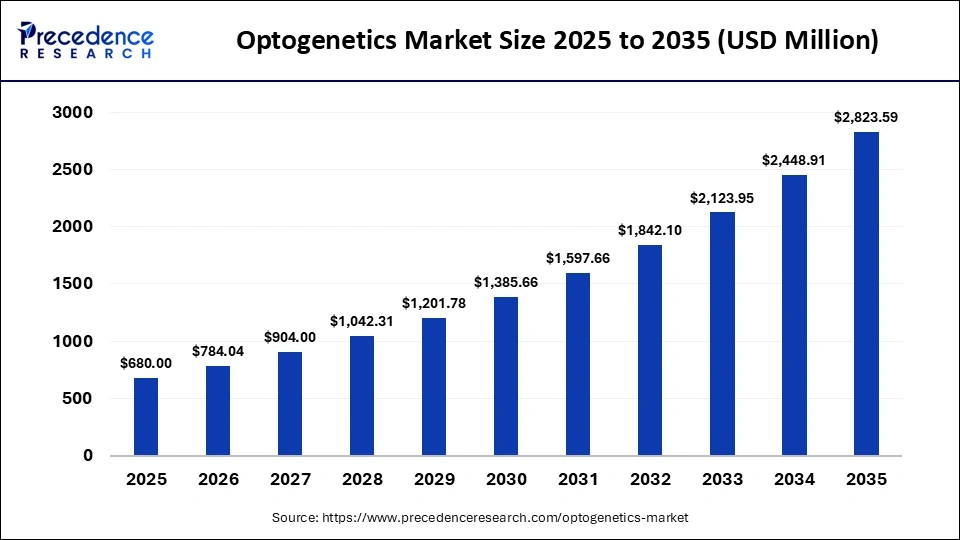
Key Takeaways
- North America led the global optogenetics market with a 40% share in 2025.
- Asia Pacific is projected to grow at the fastest rate in the market during the forecast period.
- By product type, the light equipment segment held the largest market share of 48% in 2025.
- By product type, the sensors segment is anticipated to experience the fastest growth over the forecast period.
- By application, the neuroscience segment maintained a leading position in the market with a 52% share in 2025.
- By application, the ophthalmology segment is expected to grow at the fastest rate during the forecast period.
- By technique, the in-vivo optogenetics segment dominated the global market with a 62% share in 2025.
- By technique, the in-vitro optogenetics segment is expected to grow at the fastest rate in the coming years.
- By end user, the academic & research institutes segment held a major market share of 64% in 2025.
- By end user, the pharmaceutical & biotechnology companies segment is expected to grow at the fastest rate during the forecast period.
Market Overview
Optogenetics is an innovative technology that integrates genetic engineering with light-based techniques to precisely control and monitor specific cells, particularly neurons. Widely applied in neuroscience research, it enables scientists to study complex biological functions such as memory, learning, behavior, metabolism, and sensory processing with high accuracy.
The optogenetics market is witnessing significant growth, driven by the rising demand for advanced tools to investigate and treat central nervous system (CNS) disorders. Its increasing adoption by research institutions and pharmaceutical companies highlights its potential in developing targeted therapies. Additionally, growing research funding and the emergence of biotechnology startups are accelerating market expansion. The shift toward non-invasive and precision-based treatment approaches is further fueling the demand for optogenetic solutions.
Impact of AI on the Optogenetics Market
Artificial intelligence (AI) is playing a transformative role in advancing the optogenetics market by enhancing data analysis and experimental efficiency. AI-powered tools are used to interpret complex neural activity data collected through multi-electrode arrays and to optimize light stimulation parameters in real time.
This integration improves experimental accuracy, reproducibility, and scalability by automating processes that were traditionally manual. Moreover, AI enables researchers to identify abnormal neural patterns linked to neurological disorders and supports the discovery of new therapeutic targets, ultimately accelerating innovation in precision medicine.
Key Optogenetics Market Trends
- Rising Application in Neurological Disorders: Increasing use of optogenetics in studying and potentially treating conditions such as Parkinson’s disease and epilepsy is driving research and clinical interest.
- Advancements in Technology: The development of wireless and miniaturized light-delivery systems is improving precision, flexibility, and real-time control in optogenetic experiments.
- Growing Industry Investments: Expanding investments from biotechnology and pharmaceutical companies are boosting innovation in gene editing and optical technologies, strengthening product pipelines and encouraging strategic collaborations for next-generation therapies.
Market Scope
| Report Coverage | Details |
| Market Size in 2025 | USD 680.00 Million |
| Market Size in 2026 | USD 784.04 Million |
| Market Size by 2035 | USD 2,823.59 Million |
| Market Growth Rate from 2026 to 2035 | CAGR of 15.30% |
| Dominating Region | North America |
| Fastest Growing Region | Asia-Pacific |
| Base Year | 2025 |
| Forecast Period | 2026 to 2035 |
| Segments Covered | Product Type, Application, Technique, End User, and Region |
| Regions Covered | North America, Europe, Asia-Pacific, Latin America, and Middle East & Africa |
Regional Insights
The global optogenetics market demonstrates strong regional variation, with North America leading, followed by Europe, while Asia-Pacific emerges as the fastest-growing region. Emerging markets in Latin America and the Middle East & Africa are gradually gaining traction.
North America dominates the optogenetics market, accounting for the global share. This leadership is driven by robust research infrastructure, high funding from organizations like the NIH, and a strong presence of biotechnology and pharmaceutical companies. The United States leads the region, supported by extensive academic collaborations and early adoption of advanced neurotechnologies.
Europe holds a significant market share, supported by strong government funding and collaborative neuroscience research programs. Countries such as Germany, the UK, and France are at the forefront of optogenetics innovation, with a focus on translational research and regulatory alignment. The region emphasizes ethical frameworks and clinical application development.
Asia-Pacific is the fastest-growing region, currently contributing global market and expected to expand further. Growth is fueled by increasing investments in biotechnology, rising healthcare expenditure, and expanding neuroscience research in countries like China, Japan, South Korea, and India. The region is also becoming a hub for clinical trials and cost-effective manufacturing.
Latin America is experiencing gradual growth, driven by improving healthcare infrastructure and increasing awareness of neurological disorders. Countries such as Brazil and Mexico are investing in research collaborations and adopting advanced technologies, although market penetration remains moderate.
The Middle East & Africa region represents a nascent but emerging market, contributing a smaller share of global demand. Growth is supported by rising healthcare investments, expanding research capabilities, and international collaborations. Adoption is currently concentrated in select advanced research institutions.
Get Sample Link: https://www.precedenceresearch.com/sample/8274
Also Read : https://healthcareprism.com/abdominal-aortic-aneurysm-repair-market/