
The microservices in healthcare market is witnessing rapid transformation as healthcare systems globally shift toward digital, scalable, and interoperable IT infrastructures. The market size was valued at USD 1.90 billion in 2025 and is projected to grow from USD 2.25 billion in 2026 to approximately USD 10.46 billion by 2035, expanding at a remarkable CAGR of 18.60% during the forecast period.
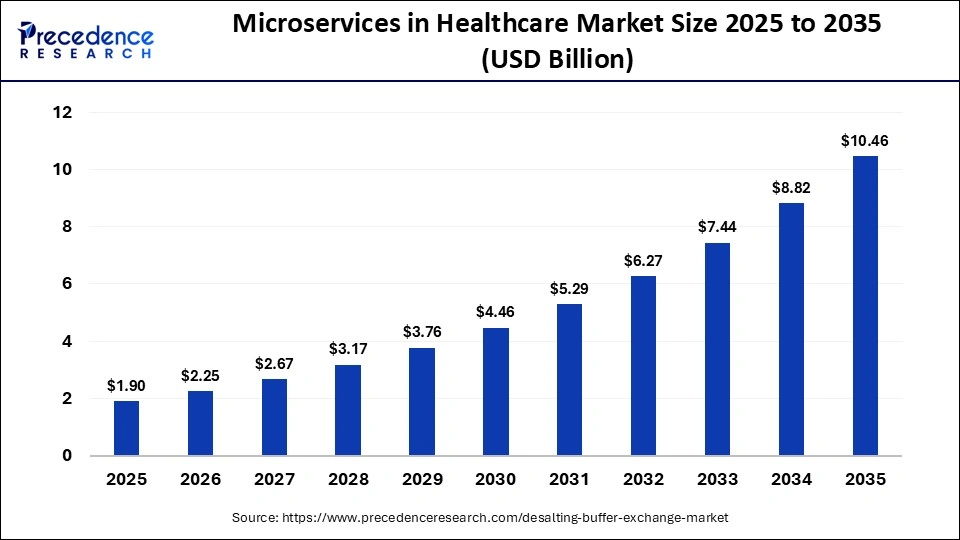
This growth is primarily driven by the increasing digitization of healthcare services, rising adoption of cloud computing, and the need for flexible, modular IT systems. Microservices architecture enables healthcare providers to break down complex monolithic systems into smaller, independently deployable services, enhancing efficiency, scalability, and system resilience.
Read Also: Optogenetics Market
Key Takeaways
- North America dominated the market with a 40% revenue share in 2025
- Asia Pacific is expected to grow at the fastest CAGR through 2035
- By component, platform & tools held the largest share of 62% in 2025
- Services segment is projected to grow at the fastest rate
- By deployment, cloud-based solutions accounted for 60% market share
- By application, clinical management systems led the market
- By end user, healthcare providers dominated with a 52% share
Understanding Microservices in Healthcare
Microservices architecture in healthcare refers to a modern approach to software development where applications are built as a collection of small, loosely coupled services. Each service performs a specific function such as patient data management, billing, or diagnostics.
This approach allows healthcare organizations to:
- Improve interoperability between systems like EHRs and telemedicine platforms
- Scale individual services independently
- Enhance system flexibility and innovation
- Reduce downtime and operational risks
Impact of Artificial Intelligence (AI)
Artificial Intelligence is playing a transformative role in accelerating the adoption of microservices in healthcare.
AI-powered tools such as:
- Natural Language Processing (NLP) for medical documentation
- Predictive analytics for disease forecasting
- AI-driven diagnostics
…are being deployed as independent microservices. This enables healthcare providers to upgrade specific functionalities without overhauling entire systems, improving both efficiency and patient outcomes.
Market Trends
1. Rising Demand for Interoperability
Healthcare organizations are increasingly focusing on seamless integration of diverse data sources such as EHRs, lab systems, and wearable devices. Microservices enable smooth communication across these platforms.
2. Growth of Telemedicine
The expansion of telehealth services is significantly boosting demand. Microservices support modular features like video consultations, appointment scheduling, and payment processing.
3. Regulatory Compliance Requirements
Strict regulations such as HIPAA and GDPR are encouraging the adoption of microservices, as they allow better data isolation and auditing capabilities.
4. Shift Toward Cloud-Based Infrastructure
Cloud deployment is becoming the preferred choice due to its scalability, cost-efficiency, and remote accessibility.
Market Dynamics
Drivers
Shift Toward Cloud-Based Healthcare Platforms
Cloud computing provides a scalable and cost-effective infrastructure for deploying microservices. Healthcare providers can efficiently manage large volumes of patient data while reducing IT costs.
Increasing Digital Transformation
Healthcare systems worldwide are rapidly modernizing legacy systems, creating strong demand for agile and modular architectures.
Restraints
Data Privacy and Security Concerns
The distributed nature of microservices increases potential entry points for cyberattacks. Ensuring robust security measures and compliance adds complexity and cost.
High Implementation Complexity
Transitioning from monolithic systems to microservices requires significant expertise, investment, and time.
Opportunities
Integration of Advanced Technologies
The combination of microservices with AI, big data analytics, and telemedicine presents significant growth opportunities for personalized healthcare and real-time decision-making.
Segment Insights
Component Insights
The platform & tools segment dominated the market with a 62% share in 2025, driven by the need for containerization, API management, and scalable IT frameworks.
Meanwhile, the services segment is expected to grow at the fastest rate due to increasing demand for consulting, system integration, and migration services.
Deployment Mode Insights
The cloud-based segment led the market with a 60% share in 2025 and is projected to grow rapidly due to:
- Lower infrastructure costs
- Scalability and flexibility
- Improved data accessibility
The on-premises segment remains relevant for organizations requiring strict data control and regulatory compliance.
Application Insights
The clinical management systems segment dominated the market in 2025 due to the increasing need to modernize EHR systems and improve patient care delivery.
The healthcare data analytics segment is expected to grow at the fastest rate, driven by the need for real-time insights and predictive analytics.
Other key applications include:
- Telehealth and remote monitoring
- Billing and revenue cycle management
End-User Insights
The healthcare providers segment held the largest share of 52% in 2025, supported by increasing adoption of digital health platforms and need for scalable IT systems.
The life sciences & pharma companies segment is projected to grow at the fastest rate, driven by:
- Increasing clinical trials
- Data-driven drug development
- Adoption of cloud-native solutions
Regional Insights
North America
North America dominated the market with a 40% share in 2025, driven by:
- Advanced healthcare IT infrastructure
- High adoption of cloud technologies
- Presence of major technology providers
The U.S. leads the region due to strong investments in digital health and regulatory compliance requirements.
Asia Pacific
Asia Pacific is expected to witness the fastest growth due to:
- Rapid digital transformation
- Expanding healthcare infrastructure
- Government initiatives supporting healthcare IT
Countries like China and India are emerging as key growth hubs.
Europe
Europe is the second-largest market, driven by:
- Increasing adoption of telemedicine
- Strong regulatory frameworks like GDPR
- Government-led digital health initiatives
Competitive Landscape
The market is highly competitive with the presence of major global players such as:
- IBM Corporation
- Microsoft Corporation
- Amazon Web Services
- Oracle Corporation
- Google LLC
- Infosys Limited
- Tata Consultancy Services
- Wipro Limited
These companies are focusing on cloud-native solutions, AI integration, and interoperability to strengthen their market position.
Recent Developments
- In 2025, NVIDIA launched multiple healthcare microservices to support generative AI-based applications.
- InfoMC introduced a microservices-based composable architecture with enhanced interoperability and user experience.
Conclusion
The microservices in healthcare market is entering a high-growth phase, driven by digital transformation, cloud adoption, and the integration of AI technologies. With healthcare systems increasingly prioritizing scalability, interoperability, and patient-centric solutions, microservices architecture is becoming a foundational component of modern healthcare IT.
As investments in healthcare digitization continue to rise globally, the market is expected to witness sustained growth, innovation, and widespread adoption across providers, payers, and life sciences organizations.
Get Sample: https://www.precedenceresearch.com/sample/8275
For inquiries regarding discounts, bulk purchases, or customization requests, please contact us at sales@precedenceresearch.com