
The global desalting buffer exchange market is emerging as a critical component of modern bioprocessing, driven by the increasing complexity of biologics manufacturing and the need for high-purity biomolecules. The market was valued at USD 1.25 billion in 2025 and is projected to grow from USD 1.36 billion in 2026 to approximately USD 2.99 billion by 2035, expanding at a CAGR of 9.10%.
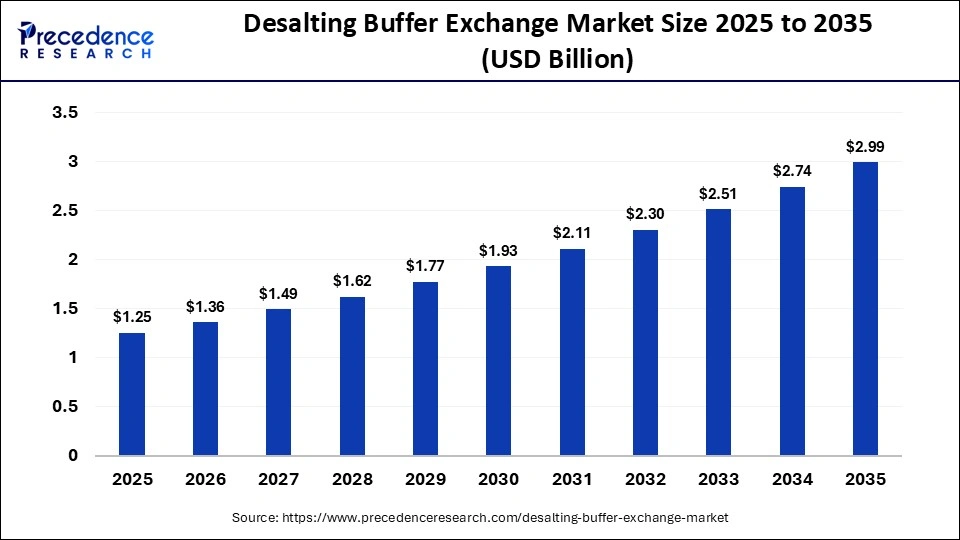
This steady growth reflects the rising demand for efficient downstream purification processes, particularly in the production of monoclonal antibodies, recombinant proteins, and advanced therapies such as cell and gene therapies.
Read Also: Microservices in Healthcare Market
Market Overview
Desalting and buffer exchange are indispensable processes in downstream bioprocessing. They are primarily used to remove unwanted salts and small molecules while transferring proteins into optimal buffer environments. These steps ensure protein stability, functionality, and compatibility with subsequent purification or formulation stages.
The increasing number of biologics approvals by regulatory bodies such as the U.S. Food and Drug Administration highlights the growing importance of purification technologies. As biologics pipelines expand, the need for precise and scalable desalting solutions becomes even more critical.
Market Growth Drivers
Rising Demand for Biologics and Biosimilars
The global surge in biologics and biosimilars production is one of the primary factors driving market growth. These therapies require highly controlled purification environments, where desalting and buffer exchange play a crucial role in maintaining molecular stability and efficacy.
Increasing Complexity of Drug Manufacturing
Modern therapeutics involve highly complex molecules that require multiple purification steps. Buffer exchange technologies ensure consistent formulation conditions, which is essential for achieving regulatory compliance and product quality.
Expansion of Biopharmaceutical Infrastructure
The rapid expansion of biomanufacturing facilities worldwide, especially in emerging economies, is significantly boosting the adoption of desalting technologies. New facilities are increasingly integrating advanced filtration and chromatography systems.
Impact of Artificial Intelligence (AI)
Artificial Intelligence is reshaping desalting and buffer exchange operations by introducing automation, predictive analytics, and process optimization.
AI-driven systems can:
- Monitor pH, conductivity, and membrane performance in real time
- Optimize buffer usage and reduce waste
- Predict equipment maintenance needs
- Enhance reproducibility and yield consistency
Integration of AI with tangential flow filtration and chromatography platforms is enabling smarter, more efficient purification workflows across biopharmaceutical facilities.
Emerging Market Trends
Transition Toward Continuous Bioprocessing
The industry is shifting from batch processing to continuous manufacturing systems. Continuous desalting and buffer exchange improve efficiency, reduce processing time, and enable real-time control over purification processes.
Sustainability and Buffer Recycling
Environmental concerns are pushing manufacturers toward sustainable practices such as buffer recycling and closed-loop processing systems. These approaches significantly reduce water consumption and operational costs.
Growth in Advanced Therapies
The rise of cell and gene therapies is creating demand for highly precise purification techniques. These therapies require stringent control over buffer conditions, further driving innovation in desalting technologies.
Integration of Filtration and Chromatography
Modern systems are increasingly combining filtration and chromatography into unified platforms, improving workflow efficiency and reducing operational complexity.
Market Dynamics
Driver: Expansion of Biosimilars Manufacturing
The growing approval of biosimilars across therapeutic areas such as oncology and immunology is increasing the need for scalable purification solutions. Desalting and buffer exchange are essential for maintaining formulation stability during biosimilar production.
Restraint: High Capital and Operational Costs
Despite technological advancements, the high cost of equipment, consumables, and maintenance remains a significant barrier. Smaller biotech firms often struggle to adopt large-scale purification systems due to financial constraints.
Opportunity: Technological Advancements in Membrane Filtration
Innovations in membrane filtration are opening new growth opportunities. Advanced membranes offer improved selectivity, higher throughput, and reduced processing times, making them ideal for large-scale applications.
Segment Analysis
Product Insights
The columns segment dominated the market with a 48% share in 2025, owing to its reliability, reproducibility, and widespread use in laboratory and pilot-scale applications. Columns are particularly effective in rapid desalting workflows and are preferred for their ease of use.
The membrane filters segment accounted for 28% share and is gaining traction due to its scalability and cost efficiency. Membrane-based systems are widely used in ultrafiltration and dialysis applications.
The kits & reagents segment is expected to grow at the fastest rate, driven by the increasing demand for ready-to-use solutions in research and early-stage drug development.
Technique Insights
The size exclusion chromatography (SEC) segment led the market with a 46% share in 2025, as it enables precise separation without altering protein structure. SEC remains a preferred method in sensitive biologics applications.
The dialysis segment continues to be widely used due to its simplicity and cost-effectiveness, especially in small-scale laboratory settings.
The ultrafiltration segment is projected to grow at the fastest rate, supported by its scalability, speed, and efficiency in handling large sample volumes.
Application Insights
The protein purification segment dominated the market with a 50% share, reflecting its critical role in biologics manufacturing.
The nucleic acid purification segment is supported by increasing demand in genomics and molecular biology research, with companies like Qiagen N.V. reporting strong demand for purification kits.
The drug development segment is expected to grow rapidly due to expanding therapeutic pipelines and increasing complexity of biologic drugs.
End-User Insights
The pharmaceutical & biotechnology companies segment led the market, driven by high demand for consistent biologics production and significant investments in R&D.
The contract research organizations (CROs) segment is projected to grow at the fastest rate due to increased outsourcing of drug development and purification processes.
Regional Analysis
North America
North America accounted for 39% of the market share in 2025, driven by a strong biopharmaceutical ecosystem, advanced research infrastructure, and high R&D investments.
The U.S. leads the region due to its robust biologics pipeline and advanced manufacturing capabilities.
Europe
Europe holds the second-largest share, supported by stringent regulatory frameworks and a strong focus on standardized bioprocessing practices. Countries like Germany play a key role due to their advanced pharmaceutical manufacturing capabilities.
Asia Pacific
Asia Pacific is the fastest-growing region, fueled by rapid expansion of biopharmaceutical manufacturing, government support, and increasing investments in healthcare infrastructure.
Competitive Landscape
Key market players include:
- Thermo Fisher Scientific Inc.
- Merck KGaA
- Sartorius AG
- Agilent Technologies
- Bio-Rad Laboratories
- PerkinElmer
These companies are investing in advanced purification technologies, automation, and sustainable solutions to maintain their competitive edge.
Recent Developments
- DuPont expanded its filtration platform with integrated technologies
- Energy Recovery Inc. launched a next-generation pressure exchanger
- Aquatech International introduced advanced electrodialysis systems
Conclusion
The desalting buffer exchange market is poised for sustained growth, supported by the expansion of biologics manufacturing, technological advancements, and increasing demand for high-purity biomolecules. As the industry moves toward automation, continuous processing, and sustainable practices, desalting and buffer exchange technologies will remain a cornerstone of modern bioprocessing.
Get Sample: https://www.precedenceresearch.com/sample/8276
For inquiries regarding discounts, bulk purchases, or customization requests, please contact us at sales@precedenceresearch.com