
What is the Multiple Sclerosis Diagnostics Market Size in 2026?
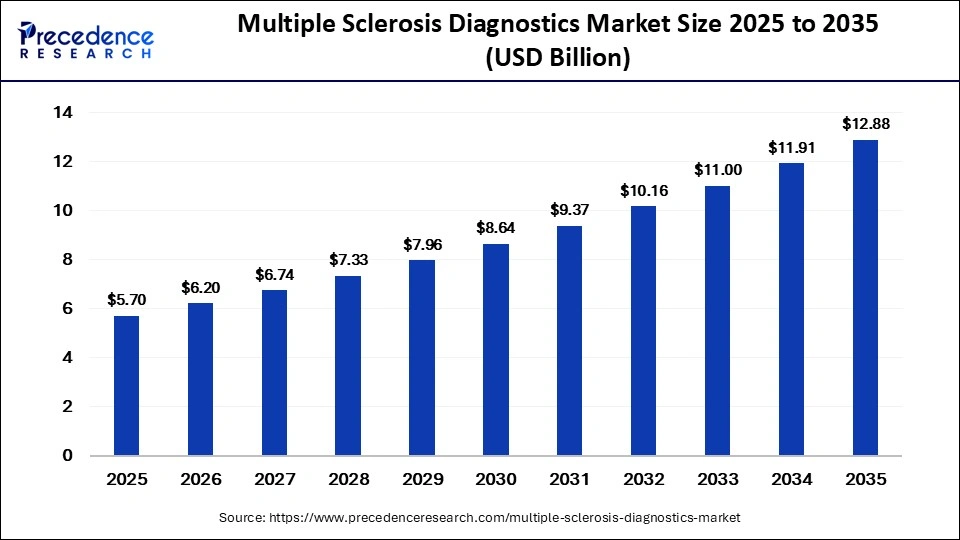
The global multiple sclerosis diagnostics market size accounted for USD 5.70 billion in 2025 and is predicted to increase from USD 6.20 billion in 2026 to approximately USD 12.88 billion by 2035, expanding at a CAGR of 8.80% from 2026 to 2035. The market is driven by technological advancements in neuroimaging, specifically the use of high-resolution, 3T magnetic resonance imaging (MRI) scanners.
Market Highlights
- North America emerged as the leading region in the global multiple sclerosis diagnostics market, capturing approximately 40% of the total market revenue in 2025.
- Asia Pacific is projected to witness the fastest growth throughout the forecast period, expanding at a CAGR of 13.2% from 2026 to 2035.
- Based on diagnostic type, the magnetic resonance imaging (MRI) segment dominated the market with a revenue share of 42% in 2025, driven by its high accuracy in MS detection and monitoring.
- The blood-based biomarker testing segment represented nearly 14% of the market in 2025 and is anticipated to register the highest growth rate of 15.5% over the forecast period due to rising demand for minimally invasive diagnostic solutions.
- Among biomarker types, the neurofilament light chain (NfL) segment held the largest market share of 34% in 2025 owing to its growing clinical relevance in assessing neuronal damage.
- The glial fibrillary acidic protein (GFAP) segment is expected to experience significant growth, advancing at a CAGR of 12.5% between 2026 and 2035 as research into neurodegenerative biomarkers accelerates.
- By disease type, relapsing-remitting multiple sclerosis (RRMS) accounted for the highest revenue contribution of 62% in 2025 due to its high prevalence among MS patients worldwide.
- The primary progressive multiple sclerosis (PPMS) segment is forecast to grow at the fastest CAGR of 11.2% during the forecast timeline, supported by increasing awareness and advancements in targeted diagnostics.
- In terms of end use, hospitals remained the dominant segment with a 44% revenue share in 2025, attributed to the availability of advanced imaging and laboratory infrastructure.
- Specialty neurology clinics are anticipated to expand at the fastest CAGR of 12.2% from 2026 to 2035, fueled by rising demand for specialized neurological care and precision diagnostics.
Market Overview
The multiple sclerosis diagnostics market comprises a broad range of technologies, diagnostic tools, and clinical services designed to identify, monitor, and evaluate multiple sclerosis (MS). The market includes advanced neuroimaging systems, laboratory-based testing solutions, cerebrospinal fluid analysis, and emerging biomarker assays used by healthcare professionals to improve diagnostic accuracy and disease management. Rising incidence of multiple sclerosis worldwide, increasing awareness regarding early diagnosis, and continuous advancements in neurological imaging technologies are major factors fueling market growth. Additionally, the growing emphasis on personalized treatment approaches and improved patient outcomes is accelerating the adoption of innovative diagnostic solutions.
Impact of AI on the Multiple Sclerosis Diagnostics Market
Artificial intelligence is playing a transformative role in reshaping the multiple sclerosis diagnostics industry by improving the speed, precision, and efficiency of disease detection. AI-powered algorithms can analyze MRI scans and laboratory data more accurately, helping clinicians identify subtle neurological changes that may be difficult to detect through conventional methods. These technologies also support predictive analytics by assessing disease progression, relapse risks, and patient response to therapies. Furthermore, the integration of AI with digital health platforms, wearable devices, and smartphone-based monitoring applications is enabling continuous real-time assessment of mobility, balance, cognitive performance, and other neurological functions, supporting more proactive disease management.
Multiple Sclerosis Diagnostics Market Trends
The market is witnessing a strong shift toward minimally invasive and highly sensitive diagnostic techniques. Blood-based biomarker testing, particularly serum neurofilament light chain (NfL) assays, is gaining significant traction as it enables early detection of neuronal damage and helps monitor disease progression without relying heavily on invasive spinal tap procedures.
Another key trend shaping the industry is the growing importance of early and accurate disease classification. Timely identification of MS subtypes allows neurologists to initiate targeted disease-modifying therapies at earlier stages, helping reduce disability progression and improve long-term neurological outcomes. In addition, increasing investments in precision medicine, biomarker discovery, and advanced imaging technologies are expected to further strengthen the evolution of the multiple sclerosis diagnostics market in the coming years.
| Report Coverage | Details |
|---|---|
| Market Size in 2025 | USD 5.70 Billion |
| Market Size in 2026 | USD 6.20 Billion |
| Market Size by 2035 | USD 12.88 Billion |
| Market Growth Rate (2026–2035) | CAGR of 8.80% |
| Largest Market | North America |
| Fastest-Growing Region | Asia Pacific |
| Base Year | 2025 |
| Forecast Period | 2026 to 2035 |
| Segments Covered | Diagnostic Type, Biomarker Type, Disease Type, End-use, Technology, and Region |
| Regional Coverage | North America, Europe, Asia Pacific, Latin America, and Middle East & Africa |
Opportunity
Predictive Diagnostic Software
The predictive diagnostic software represents the most robust opportunity in the market by transforming care from reactive symptom management to proactive precision medicine. It solves critical clinical bottlenecks by allowing earlier detection, tracking subtle progression, and thus, personalizing therapies before irreversible neurological damage occurs.
Regional Insights
North America continues to lead the multiple sclerosis diagnostics market due to its advanced healthcare infrastructure, strong adoption of innovative diagnostic technologies, and growing focus on early disease detection. The region benefits from high awareness regarding multiple sclerosis, increasing availability of specialized neurology centers, and significant investments in biomarker research and AI-driven diagnostic platforms. The United States remains a major contributor owing to the presence of leading pharmaceutical and diagnostic companies, favorable reimbursement frameworks, and rising utilization of MRI and blood-based biomarker testing.
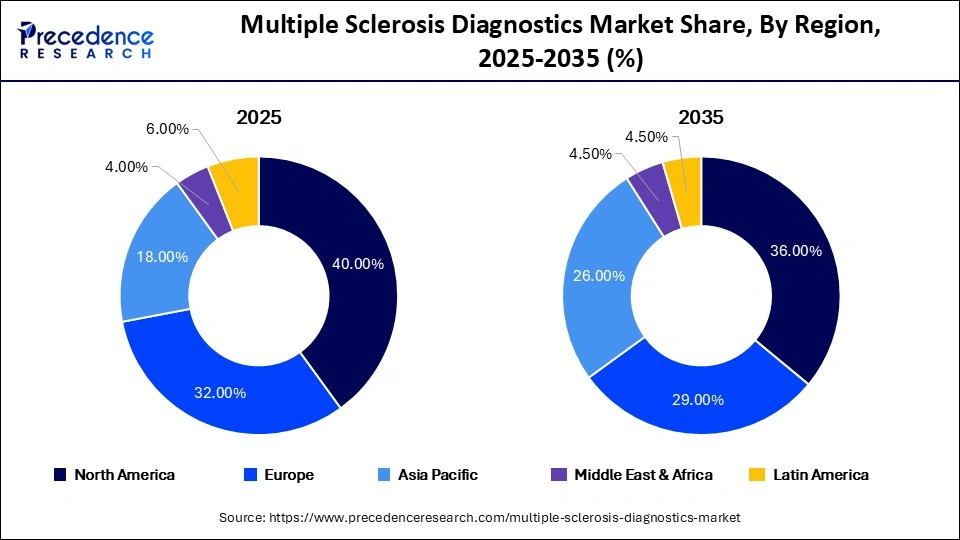
Europe represents a significant market for multiple sclerosis diagnostics, supported by increasing government healthcare spending and a strong emphasis on neurological research. Countries such as Germany, the United Kingdom, and France are witnessing rising adoption of advanced neuroimaging systems and precision diagnostic tools. The growing prevalence of autoimmune and neurological disorders, combined with supportive healthcare policies and collaborative research initiatives, is driving market expansion across the region. Additionally, increasing focus on personalized medicine is encouraging the integration of biomarker-based diagnostics into clinical practice.
Asia Pacific is expected to experience the fastest growth during the forecast period due to improving healthcare infrastructure, rising awareness regarding neurological diseases, and increasing access to advanced diagnostic technologies. Rapid economic development in countries such as China, India, and Japan is contributing to higher healthcare investments and expansion of specialty neurology clinics. The growing adoption of AI-powered imaging technologies, coupled with increasing demand for early and accurate diagnosis, is further supporting market growth in the region.
The multiple sclerosis diagnostics market in Latin America is gradually expanding as healthcare systems continue to modernize and awareness of neurological disorders increases. Brazil and Mexico are among the key markets driving regional growth due to improving diagnostic capabilities and increasing access to MRI technologies. Government initiatives aimed at strengthening healthcare services and rising investments in laboratory infrastructure are expected to create new opportunities for diagnostic providers in the coming years.
The Middle East & Africa market is witnessing steady growth driven by improving healthcare accessibility and increasing investments in advanced medical technologies. Countries in the Gulf region are focusing on strengthening neurological care services and expanding access to specialized diagnostic centers. Although challenges such as limited awareness and unequal healthcare access persist in certain areas, rising adoption of modern imaging systems and growing emphasis on early disease diagnosis are expected to support long-term market development.
Multiple Sclerosis Diagnostics Market Key Players
- F. Hoffmann-La Roche Ltd.
- Siemens Healthineers
- GE HealthCare
- Thermo Fisher Scientific
- Qiagen N.V.
- Abbott Laboratories
- Danaher Corporation
- Philips Healthcare
- Canon Medical Systems
- Bio-Rad Laboratories
- Quest Diagnostics
- Quanterix Corporation
- Agilent Technologies
- Merck KGaA
- PerkinElmer
Recent Developments
- In April 2026, Roche declared that its Elecsys Neurofilament Light Chain (NfL) test had received CE mark approval for the detection of neuroinflammation in patients diagnosed with relapsing remitting multiple sclerosis (RRMS). The test brings meaningful innovation to MS disease management, providing clinicians a minimally invasive way to monitor the biological damage which is caused by multiple sclerosis.
- In April 2025, QIAGEN declared that plans are advancing to launch three new sample preparation instruments during 2025 and 2026 to expand and even strengthen its portfolio for automated sample preparation.
Segments Covered in the Report
By Diagnostic Type
- Magnetic Resonance Imaging (MRI)
- Cerebrospinal Fluid (CSF) Analysis
- Evoked Potential Testing
- Blood-based Biomarker Testing
- Optical Coherence Tomography (OCT)
- Molecular & Genetic Diagnostics
By Biomarker Type
- Neurofilament Light Chain (NfL)
- Oligoclonal Bands (OCBs)
- Glial Fibrillary Acidic Protein (GFAP)
- Cytokine Biomarkers
- Other Neurological Biomarkers
By Disease Type
- Relapsing-Remitting Multiple Sclerosis (RRMS)
- Secondary Progressive Multiple Sclerosis (SPMS)
- Primary Progressive Multiple Sclerosis (PPMS)
- Progressive-Relapsing Multiple Sclerosis (PRMS)
By End-use
- Hospitals
- Diagnostic Laboratories
- Specialty Neurology Clinics
- Academic & Research Institutes
By Technology
- Imaging Technologies
- Immunoassays
- Molecular Diagnostics
- AI-based Diagnostic Analytics
By Region
- North America
- Latin America
- Europe
- Asia-pacific
- Middle and East Africa
Also Read Our Latest Article : AI in Pharmaceutical Market
Get Smaple Link : https://www.precedenceresearch.com/sample/8433